5 Teaching Myths That Are Quietly Hurting Your Students
From learning styles to "easy means learned," these five teaching myths feel true — but the research says otherwise. Here's what cognitive science actually proves, and simple classroom strategies that work.
What cognitive science actually says about learning styles, forgetting, and desirable difficulty
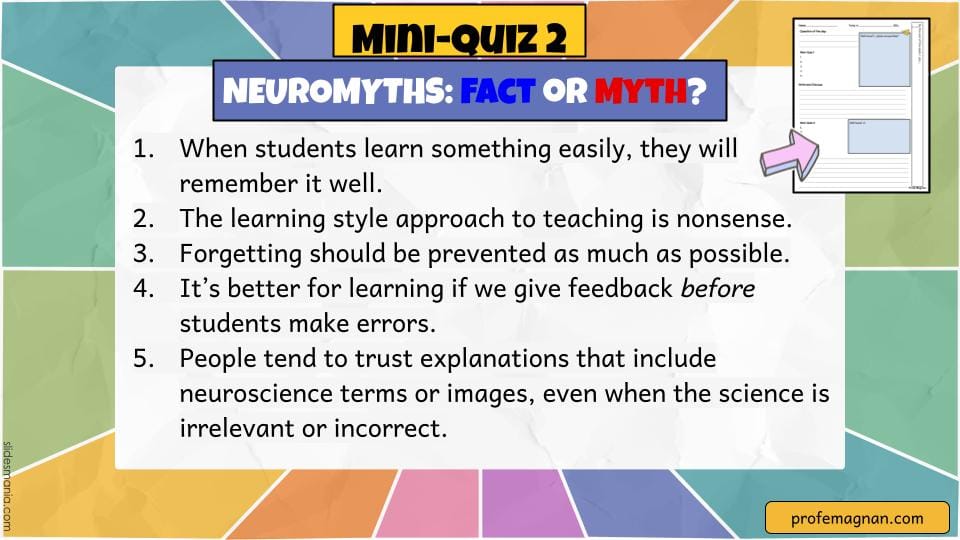
I love shortcuts, hacks, and clever teaching tricks, and so does our brain. It’s easy to get pulled in by catchy ideas: learning styles, color-coded brains, “just immerse them in language, and they’ll pick it up.” They feel true. I remember fully buying into learning styles early in my career, organizing my lessons around “visual, auditory, and kinesthetic” students, and thinking it was helping. Turns out... not so much.
We’re wired to trust what feels right, what everyone else says, what we hear in PD sessions or casual teacher conversations, or simply what seems intuitive. And that’s exactly how myths sneak in. But when you start poking at the research, things get messy… in a good way. Real learning science is weird, fascinating, and actually super helpful in the classroom.
So, let’s clear a few of them up.
Myth #1: “If it’s easy, they’ll remember it.”
The cognitive load myth: effortless learning isn’t always real learning
It’s tempting to think that if students breeze through something, they must know it. But as Pooja Agarwal explains in Powerful Teaching (2019), when learning feels easy, students often experience an illusion of mastery: they feel confident but haven’t really encoded the material deeply. Cognitive science shows the same thing. If learners aren’t challenged, memory stays fragile (Dunlosky & Metcalfe, 2009; Brown, Roediger, & McDaniel, 2014). Confidence does not equal accuracy.
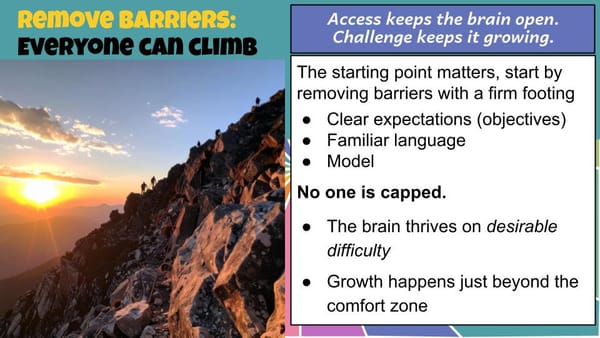
I see this in my own family all the time. My son sometimes comes across as overconfident about his lacrosse skills. He’s quick and sure he can score. And his meatball-making skills? He insists they’re unbeatable. But when he gets out on the field or tries a new recipe twist in the kitchen, that confidence doesn’t often match his performance, and he feels the disappointment when things don’t go as planned. He learns the most when he struggles a bit, makes mistakes, and then corrects them. That’s exactly what Agarwal (2019) calls desirable difficulty. Effortful learning, the kind that comes with a little frustration and a few setbacks, makes knowledge stick (Bjork, 1994; Roediger & Butler, 2011).
For our students, when they struggle just enough to retrieve knowledge and then succeed, that effort strengthens learning (Roediger & Butler, 2011). We don’t want learning to feel hard for its own sake, but we do want students working, thinking, and reaching. Struggle a little, succeed, and that memory gets stronger.
My classroom hack: build in retrieval practice, spaced review, and low-stakes quizzes. Make students work for it, kindly. Keep the stakes low, normalize forgetting, and celebrate effort. I tell students all the time: “Feeling stuck? That’s your brain figuring out the next step.” No grades, no shame, just lots of opportunities to try, retrieve, and try again.
A little effort really does go a long way. When students work to pull knowledge back from memory, that act strengthens learning far more than effortless review ever could.
Myth #2: “Teaching to learning styles improves outcomes.”
Ah, learning styles. Visual learners, auditory learners, kinesthetic learners… I fell hard for this one because I wanted to be an auditory learner. I love audiobooks and podcasts; anything where I can fold laundry, do dishes, or drive and still learn something. It’s definitely my preferred way to take in information. But here’s the catch: preference isn’t the same as effective learning. Just because something feels easier doesn’t mean your brain learns better that way.
Learning styles have been circulating in education since the 1970s, but decades of research show there’s no convincing evidence that tailoring instruction to a student’s preferred learning style improves learning outcomes. Large reviews and meta-analyses confirm that although learners can express preferences, matching instruction to those preferences does not improve achievement (Pashler, McDaniel, Rohrer, & Bjork, 2008; Coffield, Moseley, Hall, & Ecclestone, 2004; Newton & Miah, 2017; Brown, 2023). Even studies specifically designed to combat neuromyths show that beliefs about learning styles remain widespread among educators, though targeted refutation and neuroscience literacy can help reduce them (Rousseau, 2021).
We are all cognitive learners. Our brains don’t take in information through isolated channels. Attention, memory, emotion, executive control, and sensory processing all work together during learning. What matters most is how we process, connect, and retrieve information, not whether it comes visually, auditorily, or hands-on. Engagement, repetition, retrieval practice, feedback, sleep, and the learning environment all influence how well students learn (Brown, 2023; Grospeitch & Mayer, 2019). Visuals, hands-on activities, and active recall benefit everyone because they challenge the brain in multiple ways, strengthen connections, and support long-term memory (Gkintoni, Vassilopoulos, & Nikolaou, 2025; Grospeitch & Mayer, 2019; Brown, 2023).
My classroom hack: mix it up. Vary activities, switch modalities, and keep students engaged, not because you’re matching “learning styles,” but because variety supports attention, motivation, depth of processing, and memory encoding. And honestly? That’s enough.
Myth #3: “Forgetting is bad.”
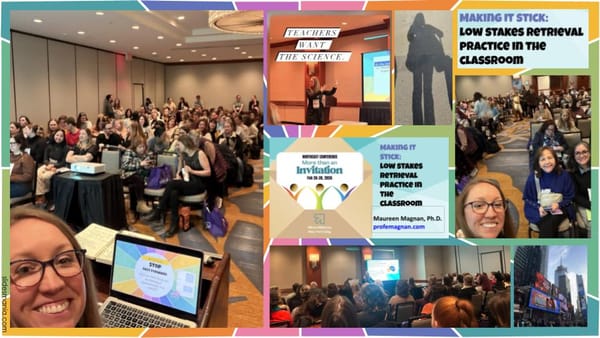
Raise your hand if you’ve ever felt like a student forgetting something is a personal failure. 🙋♀️ Oh my goodness, I’m guilty. I was reminded of this a few weeks ago at NECTFL, when a few teachers came up to me after my session and shared their experiences, something I wrote about in more detail in my post on celebrating forgetting. One teacher said her new students hadn’t remembered a grammar concept from the previous year, and she felt blamed, as if it were her fault they hadn’t retained it. Another described teaching a concept, giving examples, practicing it with students, and then… a year later, those students walk into the next class and couldn't recall a thing.
It’s so easy to feel frustrated, or even like the forgetting is a personal attack. In those moments, it’s hard not to take it personally. But here’s the twist: forgetting is actually part of learning. The trick is helping students retrieve it before the memory fades.
When students forget and then successfully retrieve information, that memory grows stronger than if they’d never forgotten at all (Karpicke & Roediger, 2008). This is called the retrieval effect: one of the most robust findings in cognitive science. Trying to prevent forgetting with endless review, cramming, or over-teaching usually backfires. Short-term performance might look good, but long-term retention? Not so much (Cepeda, Pashler, Vul, Wixted, & Rohrer, 2006). The real “problem” is usually a lack of opportunities to retrieve and practice knowledge, not the student or the teacher.
My classroom hack: let some forgetting happen, then bring it back. Use retrieval practice, spaced review, and low-stakes quizzes. Celebrate the struggle! I especially love moments when students work hard to remember something they forgot earlier. I applaud, “Wahoo! You got it back! That’s what learning looks like.” The more effortful the retrieval, the bigger the celebration. I remind them, “You’re going to be one of the few who still remember this next year!” Those moments aren’t just about content; they’re about showing students that effortful thinking builds real, lasting learning.
Myth #4: “Give feedback before students make mistakes.”
Instinct says, “Stop them before they go wrong!” Makes sense, right? But research shows the opposite: let students try first. Generating errors is powerful. When students attempt to retrieve or apply something before receiving feedback, they engage more actively, notice gaps, and think harder (Hattie & Timperley, 2007; Bjork & Bjork, 2011). Feedback lands with impact when there’s something concrete to fix, not as a preemptive correction.
I saw this in action during a lesson I gave on Atomic Habits, where students had to choose a habit in their life they wanted to address or change and follow James Clear’s four laws of habit: make it obvious, make it attractive, make it easy, and make it satisfying (I’ll write more about this in the future - the unit keeps evolving). As part of the lesson, I gave students sentence stems to practice using rendirse and desafiarse, connecting their habit reflections to authentic language use. I caught myself wanting to nip errors in the bud before they even attempted them. But when I stepped back and let them try first, the magic happened: students made small mistakes, wrestled with the verbs, and then corrected themselves with guidance. One student wrote a sentence that completely flipped the meaning, and I got to celebrate it: “Oh my gosh, amazing catch, Adam! You’re going to be one of us who still remembers this next month!” That moment wasn’t about me correcting them. It was about them actively thinking, noticing the gap, and learning it for real, all while connecting language practice to a habit they were actually trying to build.
My classroom hack: productive struggle + targeted feedback = stronger learners. Let students wrestle with the material a bit, then guide them. They learn they can figure things out on their own, even when no one is holding their hand. And honestly, that confidence and independence? That’s the real win.
Myth #5: “If it sounds like neuroscience, it must be true.”
Throw in a brain scan or a few neuroscience-y terms, and suddenly an idea feels legit. But flashy language doesn’t equal evidence.
Weisberg and colleagues (2008) ran a study with college students. They gave participants explanations of psychological phenomena. Some included irrelevant neuroscience details like “neural activation” or fMRI images, others didn’t. Even when the brain info added no real value, students rated those explanations as far more satisfying and credible. In other words, just sprinkling in “brain stuff” made people think it was true, even when it wasn’t. Weisberg and colleagues (2008) call it the “seductive allure of neuroscience.” And they’re right, it sneaks up on all of us.
I watched this play out at a PD I went to, where they brought in a new “neuroscience-backed” program. Suddenly, everyone in the meeting was intrigued. I caught myself thinking, maybe this is the magic trick I’ve been missing! But when I dug into the research data and compared it to what actually worked in my classroom activities, the results didn’t match.
As Pooja Agarwal emphasizes in Powerful Teaching (2019), flashy neuroscience language doesn’t automatically mean something is evidence-based. The evidence that actually moves the needle for learning comes from decades of cognitive psychology: retrieval practice, spaced practice, and desirable difficulty. The fancy terms can sound impressive, but what really works are strategies that help students think, struggle productively, and remember. That’s the kind of brain work that actually changes learning.
My classroom hack: always ask for the research. Look for replicated studies, not just brain metaphors (Blanchard et al., 2014). The best practices come from your experience with students and what cognitive science shows actually works. You don’t need fMRI images or buzzwords to see results. And keep celebrating when your students think critically. They’re the ones you can teach to see past the glittery jargon and learn what matters.
The takeaway
Replacing myths with research-backed strategies doesn’t just make us better teachers; it lets us be honest with our students about how learning really happens.
When students understand the why, they become gentler with themselves. They don’t see forgetting as failure. They notice that easy doesn’t always mean learned, and they begin to embrace the struggle as part of growing, exactly what Agarwal (2019) describes as desirable difficulty. As a teacher, a researcher, and a mom, witnessing that shift in thinking and the relief and genuine confidence it brings is everything.
References
Agarwal, P. K. (2019). Powerful teaching: Unleash the science of learning. Jossey-Bass.
Bjork, R. A. (1994). Memory and metamemory considerations in the training of human beings. In J. Metcalfe & A. Shimamura (Eds.), Metacognition: Knowing about knowing (pp. 185–205). MIT Press.
Bjork, R. A., & Bjork, E. L. (2011). Making things hard on yourself, but in a good way: Creating desirable difficulties to enhance learning. In M. A. Gernsbacher, R. W. Pew, L. M. Hough, & J. R. Pomerantz (Eds.), Psychology and the real world: Essays illustrating fundamental contributions to society (pp. 56–64). Worth Publishers.
Blanchard, M. R., et al. (2014). Evaluating “brain-based” claims in education: How neuroscience does and doesn’t inform teaching. Educational Psychology Review, 26(1), 1–30. https://doi.org/10.1007/s10648-014-9262-7
Brown, S. B. R. E. (2023). The persistence of matching teaching and learning styles: A review of the ubiquity of this neuromyth, predictors of its endorsement, and recommendations to end it. Frontiers in Education, 8, 1147498. https://doi.org/10.3389/feduc.2023.1147498
Cepeda, N. J., Pashler, H., Vul, E., Wixted, J. T., & Rohrer, D. (2006). Distributed practice in verbal recall tasks: A review and quantitative synthesis. Psychological Bulletin, 132(3), 354–380. https://doi.org/10.1037/0033-2909.132.3.354
Coffield, F., Moseley, D., Hall, E., & Ecclestone, K. (2004). Learning styles and pedagogy in post-16 learning: A systematic and critical review. Learning and Skills Research Centre. https://www.learningandwork.org.uk/resources/learning-styles-and-pedagogy-in-post-16-learning
Dunlosky, J., & Metcalfe, J. (2009). Metacognition. Sage Publications.
Gkintoni, E., Vassilopoulos, S. P., & Nikolaou, G. (2025). Brain-inspired multisensory learning: A systematic review of neuroplasticity and cognitive outcomes. Biomimetics, 10(6), 397. https://doi.org/10.3390/biomimetics10060397
Grospeitch, R., & Mayer, R. E. (2019). Multimedia learning: Principles, evidence, and applications. Cambridge University Press.
Hattie, J., & Timperley, H. (2007). The power of feedback. Review of Educational Research, 77(1), 81–112. https://doi.org/10.3102/003465430298487
Karpicke, J. D., & Roediger, H. L. (2008). The critical importance of retrieval for learning. Science, 319(5865), 966–968. https://doi.org/10.1126/science.1152408
Newton, P. M., & Miah, M. (2017). Evidence-based higher education — Is the learning styles ‘myth’ important? Frontiers in Psychology, 8, 444. https://doi.org/10.3389/fpsyg.2017.00444
Pashler, H., McDaniel, M., Rohrer, D., & Bjork, R. (2008). Learning styles: Concepts and evidence. Psychological Science in the Public Interest, 9(3), 105–119. https://doi.org/10.1111/j.1539-6053.2009.01038.x
Roediger, H. L., & Butler, A. C. (2011). The critical role of retrieval practice in long-term retention. Trends in Cognitive Sciences, 15(1), 20–27. https://doi.org/10.1016/j.tics.2010.09.003
Rousseau, L. (2021). Interventions to dispel neuromyths in educational settings — A review. Frontiers in Psychology, 12, 719692. https://doi.org/10.3389/fpsyg.2021.719692
Weisberg, D. S., Keil, F. C., Goodstein, J., Rawson, E., & Gray, J. R. (2008). The seductive allure of neuroscience explanations. Journal of Cognitive Neuroscience, 20(3), 470–477. https://doi.org/10.1162/jocn.2008.20040