Celebrating Forgetting: Lessons from NECTFL
What if forgetting isn't the problem — it's the setup? A recap of my NECTFL session on retrieval practice, spaced learning, and why the struggle to remember is exactly where learning happens.
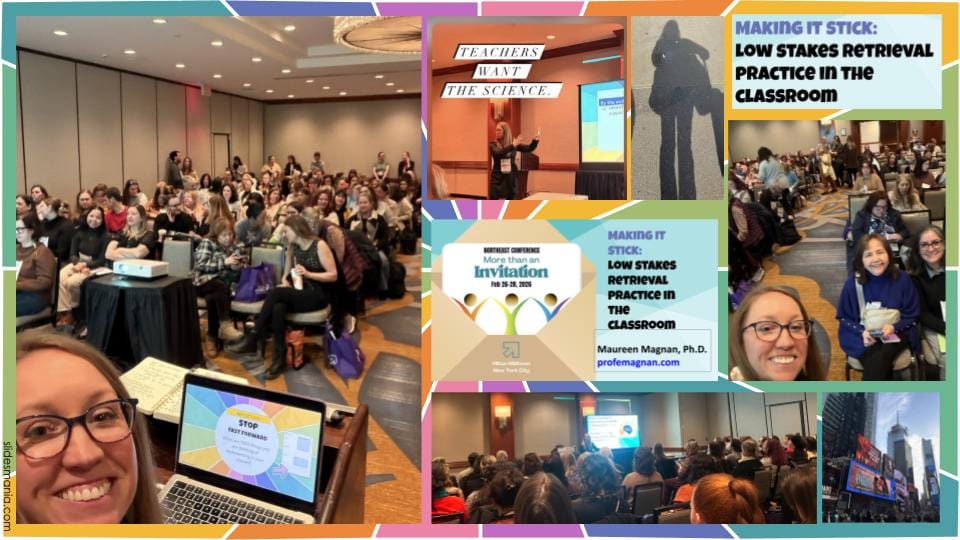
Something struck me right after my NECTFL session.
A fellow new mom came up to talk to me after I presented, asking for advice since I’m no longer new to motherhood nor teaching. She expressed how she couldn't remember anything lately...keys, why she walked into a room, what she was going to say next.
I felt it because, welp, me too.
Teaching is one of those professions where you see and interact with hundreds of people a day, juggle a million tasks, and are interrupted constantly. Honestly, it’s a little embarrassing how many times I open and close Power Teacher in the middle of grading or taking attendance. And most days I think the main reason I wear my Apple Watch is to ping my phone so I can find it somewhere in my backpack…or possibly locate my sanity.
Our brains are constantly filtering information so we don’t drown in it. The real question for us as teachers isn’t how to prevent forgetting.
It’s how to work with it.
Looking back, though, I wish I had done one thing differently: I wish I had congratulated her.
Because forgetting isn’t failure.
Forgetting actually helps our minds stay resilient and balanced. It’s something to notice and even celebrate. What our students and we truly need to remember, the things that matter, aren’t stored automatically. They need to be retrieved, effortfully, again and again. That struggle to recall is part of how learning sticks, and yes, that hard work deserves a little celebration.
That’s what we explored together on February 28 at my session at the Northeast Conference on the Teaching of World Languages in New York City.
Why Retrieval Works (and Why Rereading Doesn’t)
We started with a classic study by Henry Roediger and Jeffrey Karpicke (2006).
Two groups of students learned the same text:
• One group reread the text four times.
• The other read it once and then wrote down everything they could remember.
Later, when both groups were tested, the retrieval group had much stronger long-term memory, even though they spent less time studying.
The takeaway is powerful:
What we remember isn’t determined by how many times we see something.
It’s determined by the effortful thinking we do in working memory.
Our job as teachers isn’t just to present information. It’s to design learning experiences that get students actively thinking with the material, which helps learning stick.
The Forgetting Curve (and Why It’s Actually Good News)
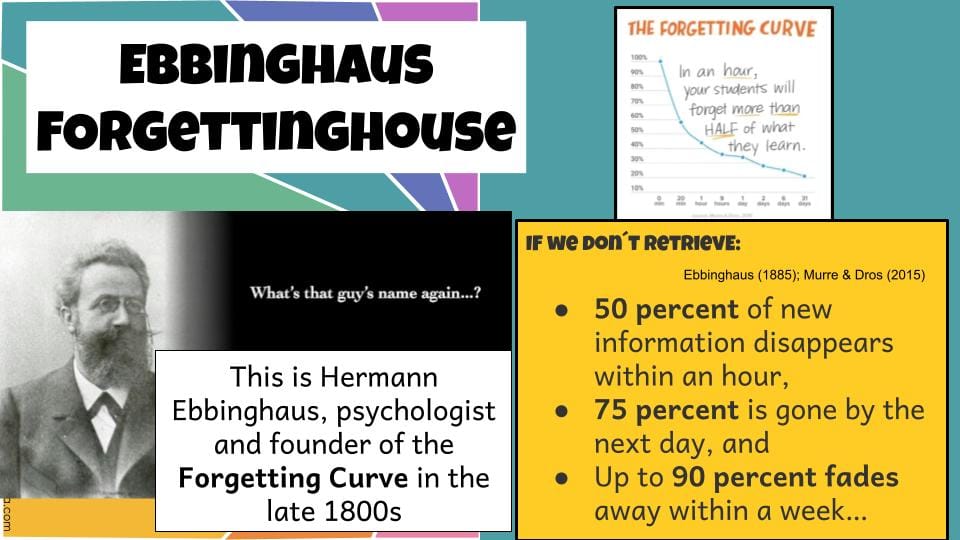
Back in the 1880s, Hermann Ebbinghaus discovered what we now call the forgetting curve.
Without retrieval, we forget roughly:
• about 50% of new information within an hour
• about 75% within a day
• up to 90% within a week
That sounds discouraging.
But here’s the hopeful part: every time we retrieve something, the forgetting curve flattens.
The memory becomes stronger, more durable, and easier to access next time.
Forgetting isn’t the enemy.
It’s the setup that allows retrieval to strengthen learning.
Four Retrieval “Power Tools” We Explored
1. Retrieval Practice (Brain Dump)
Simply pause your lesson and have students write down everything they remember.
No format. No notes. Just recall.
Researchers call this free recall, and it helps:
• strengthen learning of past material
• organize knowledge in memory
• build student confidence
To level it up, have students swap papers with a partner and add anything that was missed.
Three minutes. Big impact.
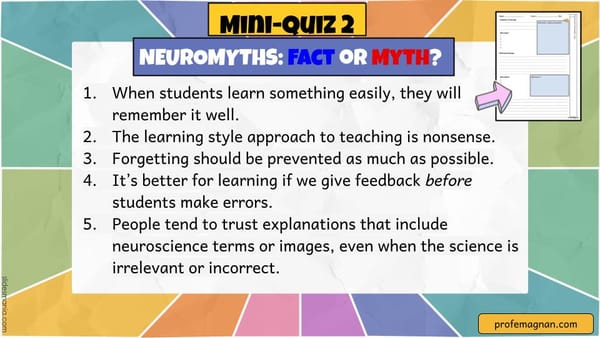
2. Mini-Quizzes (Low Stakes)
Five quick questions.
True/false. Matching. Whiteboards. Colored index cards.
Often not graded at all.
Research consistently shows that testing improves long-term learning. The key is keeping it low-stakes so students feel safe retrieving rather than stressed about performing.
3. Spacing
Don’t just retrieve what you taught today.
Reach back.
What did we learn last class?
Last week?
Last unit? (Leah McGinnity from our Edutopia Jam Session called it 1:1:1)
Teachers shared fun routines like:
• Throwback Thursday
• Blast from the Past
Spaced retrieval is one of the most powerful habits you can build in your classroom, simply by spreading out learning, at no extra cost.
4. Metacognitive Feedback
Step 1: Quick Confidence Check
After a short activity or retrieval task, ask students to rate how confident they feel about what they just recalled. Use a simple scale: 1–3, 1–5 or even thumbs up/down.
Step 2: Collect Responses
Gather answers quickly; verbally, on mini-whiteboards, sticky notes, or a Google Form.
Step 3: Highlight Gaps
Compare confidence with actual performance. Sometimes students feel confident but missed something; other times they’re unsure but got it right. Highlight mismatches for the class or let students discuss in pairs.
Why It Matters
Surfacing these gaps helps students identify what they truly know, focus their effort, and become stronger learners, not just better test takers. Low-stakes tools like the Metacognitive Rainbow (slide 52) are easy to use.
The Big Takeaway: Make Retrieval Part of Your Routine
Embed retrieval into a system that already works for you. One routine, done consistently, beats five strategies done once.
Some ideas:
- A brain dump at the start of class
- Two retrieval questions at the end
- Throwback Thursday
- Feedback Friday
Pick one. Make it yours.
Remember: the brain isn’t a bucket to pour knowledge into; it becomes more resilient every time we challenge it to remember, and celebrate!
Thanks to everyone who joined the session at NECTFL. It was a joy. And to the fellow new mom who came up after the session, I should have said it then: congratulations. You're doing the hard work. That's exactly what learning looks like.
If you want to see what teachers shared the week before, check out:
→ Making Retrieval Routines a Classroom Habit (Edutopia Jam Session)
Slides from the presentation are available here.
References
- Henry L. Roediger III & Jeffrey D. Karpicke (2006). Test-enhanced learning: Taking memory tests improves long-term retention. Psychological Science.
- Hermann Ebbinghaus (1885/1913). Memory: A Contribution to Experimental Psychology.
- Pooja K. Agarwal & Patrice M. Bain (2019). Powerful Teaching: Unleash the Science of Learning.