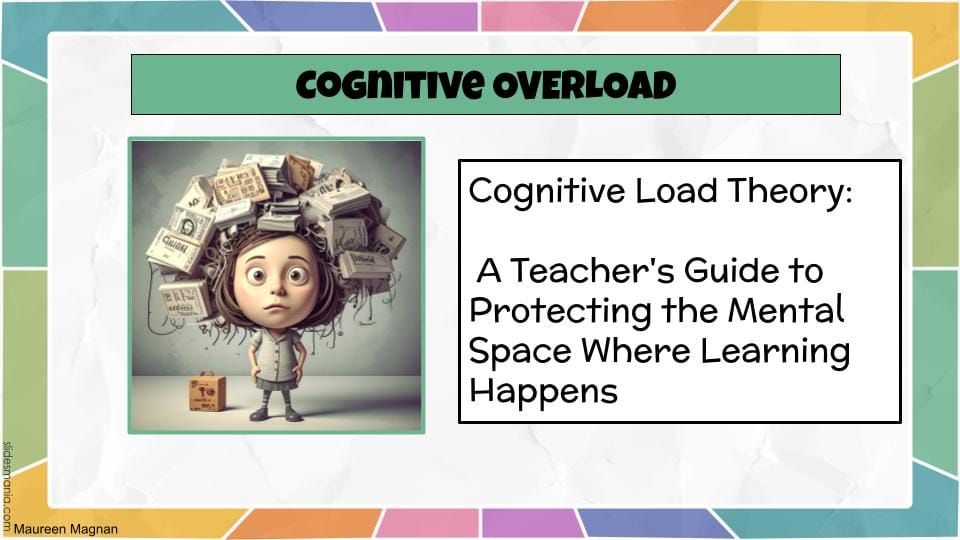
Cognitive Load Theory: A Teacher's Guide to Protecting the Mental Space Where Learning Happens
The lesson was solid. Students still froze. It's not apathy it's cognitive overload. 10 strategies to reduce it without lowering rigor
When Working Memory Overloads, Learning Stops
The lesson was solid. It was explained clearly, modeled, practiced, and revisited. And still, when it was time for students to work independently, many froze mid-task, stared blankly, or drifted off.
Was it apathy? A lack of effort? Motivation?
It's usually none of these. It's cognitive overload.
When students are asked to process too much at once, their limited working memory fills up. Thinking slows. Learning stalls. What looks like disengagement is often a brain that has simply hit capacity.
This post explains the brain science behind why students (and teachers) shut down when lessons feel overwhelming, and 10 research-backed strategies to reduce cognitive load without lowering expectations or rigor.
In this guide, you’ll learn:
- Why students shut down when working memory overloads
- What cognitive load is (and why it’s not laziness or lack of effort)
- The three types of cognitive load: intrinsic, extraneous, and germane
- 10 research-backed instructional moves that reduce overload
- What managing cognitive load looks like in real language classrooms
I’ve long grappled with the limits of working memory in my own teaching. Even when lessons were carefully planned, and content knowledge was strong, I noticed students struggled when too much information arrived at once.
I realized something uncomfortable: while I had been trained deeply in content and pedagogy, I had never been fully taught how learning actually works in the brain. My teacher preparation rarely modeled the Science of Learning in practice.
Standing in front of five classes of around 25 students, I had to figure out how to move information out of their fragile working memory and into long-term memory. That question led me to Cognitive Load Theory and it fundamentally changed the way I teach.
Cognitive Load Affects Teachers Too, And It Shows Up in Class
Goodness, I struggle with cognitive overload on a daily basis...planning lessons, realizing I created slides crammed with too many words, juggling emails, and then discovering my glasses were on my head the whole time.
When we teach in real time, the same cognitive limits apply to us. We read the room, redirect behavior, adjust pacing, respond to emotions, and decide on the fly whether to push forward or pull back. That’s even before we layer in everything else we’re carrying: supporting students who arrive with the full complexity of their world. And oh my goodness, it feels overloaded right now.
Lately, I think about my own cognitive load as a mom, teacher, researcher, and person trying to stay informed, compassionate, and action-oriented without completely spiraling. Some days, it feels like juggling flaming torches while riding a unicycle. And when I do overload, I don't become a better educator (or mom); I become mentally (and even emotionally) unavailable to the students (and children) in front of me.
Which is the irony, isn't it?
The more we try to hold everything, the less we're able to support our students in the moment.
Reducing cognitive load isn't about lowering expectations. It's about protecting the mental space where learning, teaching, and growth can happen.
What Is Cognitive Load (and Why Teachers Should Care)
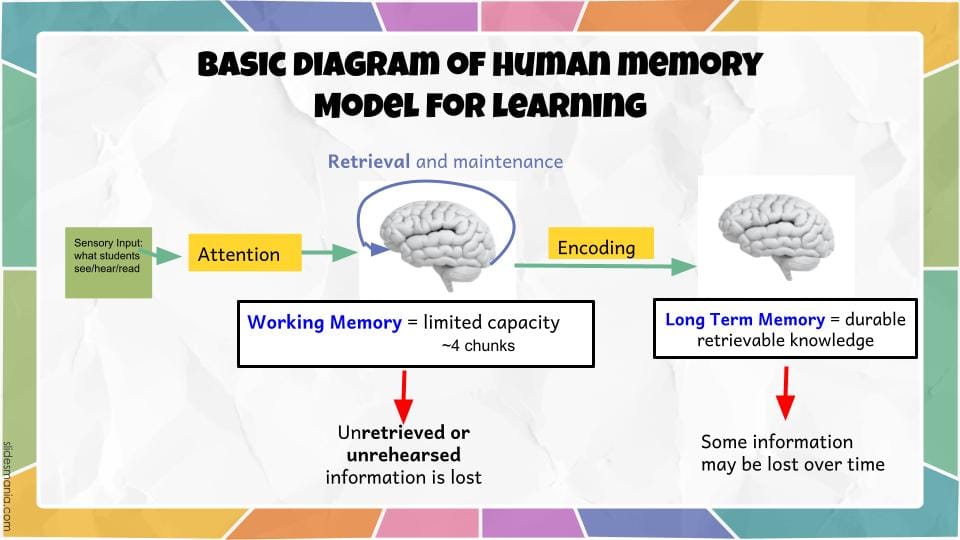
Cognitive Load Theory explains how learning depends on the interaction between:
- Working memory (where thinking happens)
- Long-term memory (where knowledge is stored)
Working Memory: Powerful but Tiny
Working memory is where students:
- Process new language (wait, does gusta take me or yo?)
- Connect it to what they already know (oh, this is like that thing we did with encantar)
- Make decisions and produce output (should I say fui or fue?)
The catch? Working memory has a severely limited capacity. When it's overloaded, learning stalls, not because students aren't motivated or "trying hard enough," but because their brains are simply maxed out.
When we see a student’s face go blank or drift off mid-sentence, we might think: They're not paying attention. They don't care. But it may just be that their working memory is full, and that our next instruction, however brilliant, may have nowhere to land.
How much can working memory hold?
Working memory can actively hold about 3–4 meaningful units of information at a time, and often fewer in real classrooms.
When I first learned this, I laughed. Then I cried a little. Because I was regularly asking my students to hold 7, 8, maybe 10 things at once...Ok, who am I kidding, in my earlier teaching, a full textbook list of vocabulary words...no wonder they looked overwhelmed.
What does "3–4 units" actually mean?
These are chunks, not raw items. A chunk is whatever the learner treats as one coherent unit.
A chunk can be:
- One word (gusta)
- One image (a picture of someone eating)
- One idea (likes and dislikes)
- Or several items grouped meaningfully (e.g., "preterite vs. imperfect" as one chunk instead of twelve separate rules)
So capacity depends heavily on:
- Prior knowledge (what they walked in knowing)
- Familiarity (have they seen this pattern before?)
- Automaticity (can they do it without thinking?)
This is why experts appear to "hold more"; they don't. Their information is just more compressed.
When I ask a heritage speaker to talk about their weekend, they're not using 15 chunks of working memory. They've automated so much that the whole task might only take 2-3 chunks. But my novice learner? Same task, all 15 chunks needed, working memory maxed out before they've said three words.
⏱️ How long does information last?
Unrehearsed information in working memory lasts ~10–20 seconds
Unless it's:
- Rehearsed or retrieved
- Externalized (written, drawn, or visualized)
- Connected to prior knowledge (schema building).
- Think of schemas as filing systems in the brain. They help us organize related information into meaningful chunks.
What Is Schema Building?
Schema building happens when students connect new information to what they already know, creating organized networks of understanding. For example:
A "restaurant schema" includes: menus, ordering, paying, tipping
A "past tense schema" in Spanish includes: -ar/-er/-ir patterns, irregular verbs, time markers
Why it matters for cognitive load: When students have strong schemas, new information takes up less working memory space because it connects to existing patterns. This is why experts appear to "hold more": their knowledge is compressed into organized schemas, not scattered facts.
In practice: A student with a solid "greetings schema" can easily add "¿Qué tal?" to their existing framework. A student without that schema must process each greeting as an isolated, unrelated item; overwhelming working memory fast.
It decays quickly if attention shifts (new instructions, noise, task change).
This explains why long directions, dense slides, or new tasks piled on new language overwhelm students quickly.
Why This Matters (Especially in Language Classrooms)
In a single moment, a language learner might be asked to:
- Listen in the target language
- Decode new vocabulary
- Remember instructions
- Apply a grammar rule
- Speak with confidence
This can exceed working-memory capacity fast, leading to shutdown, guessing, or disengagement.
When Cognitive Load Is Too High, We Often See:
- Silence or shutdown
- Guessing
- Off-task behavior
- "I'm just bad at languages"
This isn't a motivation problem. It's a processing bottleneck.
Language learning is vulnerable. Cognitive overload often masquerades as lack of ability or effort, when really it's about information flow exceeding the brain's processing capacity.
Cognitive Load Theory: The Three Types
🧠 Intrinsic Load (Necessary)
The complexity inherent to the material itself: new grammar, vocabulary, task demands.
You can't remove it, but you can pace it.
In a language classroom, here's what intrinsic load looks like:
- New grammar + new vocabulary + new task format = instant overload
- Speaking while listening while trying to remember which form of the verb to use
- Reading a text with 30% unknown words while also answering comprehension questions
I used to think: Well, they just need to push through it. But throwing everything at them at once doesn't make them tougher; it makes them shut down.
How I manage it now:
- One communicative goal at a time ("Today we're learning how to apologize")
- Familiar structures + new vocabulary (or vice versa, never both at once)
- Recycled sentence frames that free up brain space for the actual content
The day I stopped trying to "cover" material and started pacing intrinsic load? That's when I saw students actually retain what we learned.
⚙️ Extraneous Load (Avoidable)
Unnecessary effort caused by poor instructional design.
This one hurts because it's on us. I say that as someone who spent years unintentionally adding extraneous load without realizing it.
Common culprits in my own classroom:
- Overly wordy instructions in the target language that students couldn't decode (I thought I was "staying in the target language" - I was actually just confusing them)
- Cluttered slides with too much text, cute graphics, and seven different fonts
- Novel task formats layered on novel language ("Today we're learning food vocabulary AND a new partner activity structure you've never seen!")
- Trying to teach too many grammar exceptions at once
- "Creative" variations that were really just inconsistency in disguise
Here's what I learned: every minute students spend trying to figure out what I'm asking them to do is a minute they're not spending on the actual language.
This is where teachers can make the biggest gains. We can't eliminate intrinsic load (language is complex!), but we absolutely can stop accidentally piling on extraneous load.
🌱 Germane Load (Desirable)
Mental effort devoted to understanding, noticing patterns, reflecting, and building schemas.
Reducing cognitive load protects this thinking.
In a language classroom, 🌱 germane load shows up as:
- Noticing patterns ("Oh — me gusta works differently")
- Reflecting on communication success, not just accuracy
- Retrieval that is short, frequent, and low-stakes
- Building metacognitive strategies
Effective teaching reduces extraneous load and manages intrinsic load while promoting 🌱 germane load.
10 Research-Backed Strategies to Reduce Cognitive Load
These aren’t trendy strategies or more things to plan. They’re small design moves that immediately reduce overload for both students and teachers. Reducing cognitive load is not about lowering expectations. It’s about protecting this kind of thinking.
1. Chunk Input
- Limit new items to 3–5 at a time
- Reuse and retrieve sentence frames and vocabulary
- Pause before adding more
Why it works: Depth beats breadth; repeated exposure moves information into long-term memory
2. Limit Directions
- Give 1–2 steps at a time
- Pair instructions with visual cues (icons, emojis, or simple images)
- Pause → check → add next step
Slide rule (7×7):
- No more than 7 words per line
- No more than 7 vertical lines total
- Fewer is better for novice learners (3–5 lines is often plenty)
Example:
👂 Listen
✍️ Write 1 sentence
🗣️ Share with partner
Same icons. Same order. Every time.
3. Use Worked Examples
- Show success before asking students to produce
- Sequence: Full model → Partial support → Independent practice
- Highlight only what matters visually (I use blue for the key words); explain orally
Why it works: Worked examples reduce extraneous load so students can focus on meaning and structure instead of guessing expectations.
4. Build Routines
- Same task structures
- Same icons
- Same order of steps every time
Examples:
- Daily warm-up: read → think → write
- Speaking routine: plan → speak → reflect
- Reading routine: gist → detail → respond
Why it works: When procedures are automatic, they no longer consume working-memory space. Students know how to work, so they can focus on what they're learning.
5. Retrieval Practice & Spaced Review
- Short, low-stakes retrieval strengthens memory
- Review vocabulary or grammar in small intervals, not crammed
- Quick quizzes, flashcards, brain dumps or asking students to write what they remember before checking notes
Why it works: The act of retrieval itself strengthens neural pathways. Spacing practice over time prevents the forgetting curve from erasing what students learned.
6. Dual Coding
- Combine visuals with words
- Images + text + verbal explanation engage multiple processing channels
- Show images for new words, have students act them out
Why it works: Creating multiple retrieval pathways helps students access knowledge from different angles. Reduces overload on a single channel because meaning isn’t carried only by words or images (Paivio, 1971; Mayer, 2001).
7. Scaffold & Fade
- Provide support early (sentence frames, word banks, guided practice)
- Remove (or don't remove and just encourage students to see if they can do without) gradually as competence grows
- Start with simple elements and gradually increase complexity
Why it works: Scaffolding reduces intrinsic load while students build schemas. As knowledge becomes automatic, removing support frees working memory for more complex tasks, gradually building independence and confidence without overwhelming learners.
8. Encourage Reflection & Metacognition
Language-class specific examples that feel authentic:
- "What helped you understand today's message?"
- "Which sentence starter made speaking easier?"
- "What did you do when you didn't know a word?"
Why it works: Metacognitive awareness helps students build transferable learning strategies (schemas). When students identify what works, they reduce future cognitive load by approaching similar tasks more efficiently. This investment in germane load pays dividends over time (Chi et al., 1988; Sweller et al., 2011).
Key points about metacognition:
- Doesn't require long writing
- Can be done in L1 or L2
- Actually reduces load over time by building strategies
9. Reduce Distractions
- Visual clutter, irrelevant displays, or overly long texts increase extraneous load
- Simplifying classroom materials and environment helps students focus on essential content
- White space is your friend...if it feels "too empty," it's probably right
Why it works: Every unnecessary element on a slide or in the classroom environment consumes precious working memory capacity. Removing extraneous visual and auditory distractions means more cognitive resources available for actual learning.
Confession: Even knowing this, I sometimes spend 10 minutes cleaning a slideshow only to realize I’ve added five new distractions in the process.
10. Connect to Prior Knowledge
When students can connect new content to what they already know (schemas), it lessens the effort needed to process and remember the new information. Use questions, analogies, examples, poems, songs, or jokes that tap into familiar knowledge
Why it works: When new information connects to existing schemas, it requires fewer working memory "slots" because it integrates with what's already automated in long-term memory. This is why experts can hold more; their knowledge is compressed into meaningful chunks.
Make It Doable: Small Design Moves That Reduce Cognitive Load
Speaking Task: Version 1 (Overload): "Okay everyone, turn to your partner and talk about yesterday. Use at least 3 past tense verbs. Go!"
Result: Silence. Panic. Students freeze, off-task chatter begins, one student says "I'm just bad at Spanish."
Speaking Task: Version 2 (Managed Load):
- Show 3 sentence frames on the board with icons
- Give 30 seconds of planning time: "Write 1 verb you might use"
- Model one example: "Ayer vi el Superbowl"
- Then: "Now turn and share with your partner"
Result: Students speak. Even hesitant learners produce language.
Same task. Different cognitive load.
A Note on Engagement
One of the biggest mistakes we make is confusing engagement with learning. I know. This one's hard to hear, especially when we've been told that "engaging lessons" are the goal.
But here's what I've observed: students can be highly engaged in a discovery-based activity, moving around, talking, collaborating, and still retain almost nothing if they lack the schemas to make sense of what they're discovering.
In early learning phases, problem-based or open-ended tasks can actually overload working memory. Students look busy. They seem excited. But when I check back the next day? The learning didn't stick.
The better question isn't "Were they engaged?" It's "What did they actually retain?"
Productive struggle is important, but it must be carefully designed and achievable, not overwhelming. There's a sweet spot between "too easy" and "brain gives up."
FAQ
Does reducing cognitive load lower academic rigor?
No, and I used to worry about this too. Here's the difference: I'm not lowering expectations. I'm sequencing instruction so comprehension comes before performance. I'm not asking less of my students; I'm giving their brains the space to actually do what I'm asking.
Why do strong students seem fine while others shut down?
Your strong students have more developed schemas. The same task that takes your struggling student 12 chunks of working memory might only take your strong student 3-4 chunks. It's not that they're "smarter", it's that they've automated more, so they have more cognitive room to work with.
This is why differentiation matters. Not different content, but different amounts of scaffolding.
Should reflection be in the target language?
Not always. I give them the choice, and honestly? Some of my best metacognitive moments happen in English (or their L1). When a student can say "I got stuck because I didn't know how to say 'I was,' so I just stopped talking," that awareness is gold.
Forcing reflection into the target language when they don't have the words yet just adds cognitive load. The goal is building strategies, not performing language during every single moment.
Is productive struggle bad?
Yes, but there's a difference between productive struggle and cognitive overload.
Productive struggle: Student tries to conjugate a verb, makes an error, gets feedback, tries again. Their brain is working hard but not drowning.
Cognitive overload: Student tries to conjugate a verb they've never seen, using a grammar rule they don't understand, while listening to instructions in the target language they can't decode, and their brain just... quits.
One builds resilience. The other builds avoidance.
Why do routines matter so much?
Are the routines truly the same every time? Like, icon-for-icon, step-for-step the same?
I thought I had routines until I realized I was changing the order of activities, using different visual cues, or adding "fun variations" that were actually just novel tasks in disguise. Every variation = more cognitive load.
Now? Same warm-up structure every single day (I use the Para Empezar weekly worksheet). Same partner-talk protocol. Same icons. I change only the language, never the procedure. And suddenly, students knew how to work, so they could just focus on what they were learning.
The Big Idea
Reducing cognitive load doesn’t mean lowering expectations.
It means designing instruction so students' limited working memory is used for thinking, not decoding chaos.
Clear slides. Fewer words. Familiar routines.
Experts don't hold more information; their knowledge is simply more compressed.
As Professor Daniel Willingham puts it, memory is the "residue of thought." Processing in working memory is essential for long-term storage; it's the information's entry ticket to long-term memory. Let's help each other protect the mental space where growth, learning, and teaching can happen.
If You Want the Deeper Research Trail
Here are some recent syntheses, foundational studies, and practical applications that I’ve found especially useful for understanding and applying Cognitive Load Theory in classrooms.
Key Research (Foundational Works)
Cowan, N. (2001). The magical number 4 in short-term memory: A reconsideration of mental storage capacity.
Oberauer, K., et al. (2016). Benchmarks for models of working memory.
Sweller, J., Ayres, P., & Kalyuga, S. (2011). Cognitive Load Theory.
Willingham, D. T. (2009). Why don't students like school? A cognitive scientist answers questions about how the mind works and what it means for the classroom.
Craik, F. I., & Lockhart, R. S. (1972). Levels of processing: A framework for memory research.
Recent Studies (2023–2025)
Barbieri, C. A., et al. (2023). Meta-analysis of cognitive load theory interventions in educational settings. Educational Psychology Review.
Chen, O., Paas, F., & Sweller, J. (2023). A cognitive load theory approach to defining and measuring task complexity through element interactivity. Educational Psychology Review, 35, Article 63.
Evans, P., Vansteenkiste, M., Parker, P., Kingsford-Smith, A., & Zhou, S. (2024). Cognitive load theory and its relationships with motivation: A self-determination theory perspective. Educational Psychology Review.
Lee, C. H., & Ayres, P. (2024). Using worked examples in mathematics to improve retention and reduce cognitive load. Education Sciences, 15(4), 458.
Sozio, G., Agostinho, S., Tindall-Ford, S., & Paas, F. (2024). Enhancing teaching strategies through cognitive load theory: Process vs. product worked examples. Education Sciences, 14(8), 813.
Zou, L., et al. (2025). The synergy of embodied cognition and cognitive load theory for optimized learning. Nature Human Behaviour.
Aljawarneh, Y., & Al-Omari, H. (2025). The impact of a major educational shift on cognitive load: A cross-sectional study of UAE university students. Journal of Social, Behavioral, & Health Sciences, 19.
Baxter, K., Kerr, D., et al. (2024). The application of cognitive load theory to the design of health and behavior change programs: Principles and recommendations. International Journal of Environmental Research and Public Health.
Practical Application
An Introduction to Cognitive Load Theory – The Education Hub