The Power of Eliciting Stories: Ethnographic interviews in the language classroom

"The whole study is the power of eliciting people’s stories," says Dr. Maureen Lothrop Magnan '20. Dr. Magnan, a Spanish teacher and language coordinator for Sharon Public Schools, strives for empathy through active listening for challenging attitudes towards speakers of other languages.
Spanish teacher Dr. Maureen Magnan ’20 teaches empathy through ethnography (Lesley University)
Then she read about something that might: ethnographic interviewing, a “fancy word for an active listening and observing interview,” which researchers Gail Robinson-Stuart and Honorine Nocon had used with university students to encourage positive attitudes toward speakers of a different language.
Magnan, who concentrated on Multicultural Education and Second Language Acquisition for her individually designed PhD program at Lesley, decided to try this interviewing technique on with her students. She would teach her high schoolers active listening and open ended questioning, and then ask them to interview an immigrant in the community. A survey conducted before and after the project would help her evaluate if the students’ perception of immigrants had changed. The experiment became the focus of her PhD research.
Sticking with Spanish
Magnan says she wasn’t good at many subjects in school, but Spanish stuck with her. In college, she studied abroad in Spain, then worked in an orphanage in the Dominican Republic before returning to Spain for her master’s degree. Back in Massachusetts, she became a social worker while pursuing another master’s degree, this time in social work, but she felt like she was always too late to help her clients.
“It was so reactive,” says Magnan. “The crisis had already occurred.”
She thought, “Man, I need to be on the other side of this. I need to be proactive. I want to teach.”
Changing tack, Magnan earned her Ph.D. in education instead, and since then has taught first-graders through seniors. She currently teaches Spanish and is the language coordinator for Sharon Public Schools.
Language barriers
Magnan was a teacher at Dedham high school when she began her active listening project. She started by inviting a well-liked teacher at the school who had recently become a U.S. citizen to speak to her classes. The emotional response surprised Magnan.
In the coming weeks, Magnan shared data on immigration, first person narratives, short stories and movies that portrayed the immigrant experience in America.
Then she began teaching the students active listening — how to make eye contact, how to use body language to convey interest, how to put people at ease during interviews and how to ask good questions. Magnan learned from Gail Nemetz Robinson in the creation of an acronym for the word “present” to help her students during their interviews:
Patient
Relax
Empathize
Stay positive
Examine
Notice
Take a deep breath
“They practiced this skill of just literally being present for someone else, and not having an agenda except how much can I get them to talk and tell me about themselves and their story,” says Magnan.
Students chose a variety of people to interview — from their peers to business owners. And because this was a Spanish class, all interviews would be conducted in that language.
Bias backpacks
The project had an effect on everyone involved.
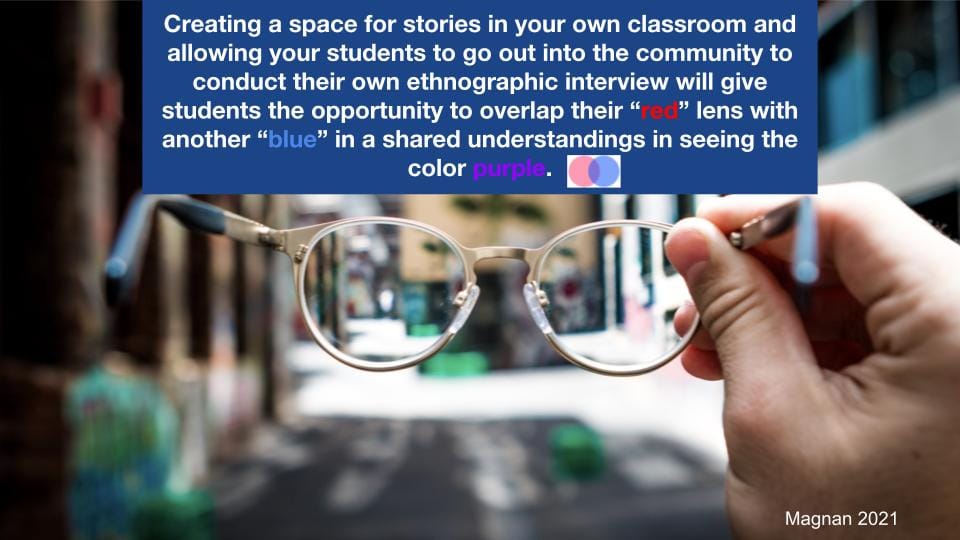
“They had to go into their interviews and take off their backpack of bias as much as they could, we took off our literal backpacks to symbolize it” says Magnan. They came out of it amazed at how candid and excited their subjects had been to speak with them.
At the outset, Magnan’s pre and post survey showed that “97 percent of the kids changed their tune on immigrants once they saw them as human beings with a story.”
It took some students longer for the empathy to kick in, but Magnan saw a change in almost everyone’s listening skills.
Some students took their interactions beyond the interview. After learning about a Spanish-speaking peer who walked to school each day during their interview, a student gave him a bike that had sat unused in her garage. Another student invited a Spanish-speaking peer to Thanksgiving dinner. Magnan did the same.
“It created this amazing familial feel to the class,” she says.
Magnan titled her thesis, “Creating Cross-Cultural Understandings in the Language Classroom through Ethnographic Interviews with Immigrants,” and detailed her experience of seeing how students’ perspectives shifted through the interview process.
The experiment had such a transformative experience on her students, that she enlisted teachers in other subject areas to implement ethnographic interviewing projects in their classes.
“The whole study is the power of eliciting people’s stories,” she says. “You can do this about any sort of controversial subject.”
The results mirrored those in her classroom, where she continues to teach ethnographic interviewing each year.