Making Metacognitive Reflection a Daily Habit with Retrieval Practice
Make metacognitive reflection a daily habit using quick retrieval practice routines that help students strengthen memory, deepen understanding, and build real learning awareness.

From Research to Routine: Make Metacognition a Habit
To be honest, I am always working on slowing down enough for language to stick. When I’m excited about a lesson, I can move and talk faster than my students can process, unintentionally turning enthusiasm into overload.
In my early years of teaching, I began to notice a pattern. When attention started to wane, or students looked lost, my instinct was to explain again, add another example, or keep going because we were “on a roll.” But what we really needed wasn’t more content. We needed a pause.
Not a long one. Not a formal reflection every time.
Micro-pauses encourage students to pull ideas from memory, notice what worked, and strengthen retention.
That’s when I realized that if metacognitive reflection truly matters (and the research is clear that it does), it couldn’t be something I saved for the end of the week. It had to become part of my daily classroom system. A built-in, habitual pause that helps students (and me) slow down and think.
That’s when I realized that if metacognitive reflection truly matters (and the research is clear that it does), it couldn’t be something I saved for the end of the week. It had to become part of my daily classroom system.
Why Metacognitive Reflection Matters
Reflection and metacognitive reflection, especially when combined with retrieval practice, is more than a routine; they’re a powerful learning tool. When students reflect regularly and retrieve their learning, they:
- Deepen understanding and retention
- Build agency and ownership of learning
- Support social–emotional growth
- Set goals and develop a growth mindset
Reflection is thinking back on an experience. Metacognitive reflection takes it a step further by focusing on how learning happened and why. It sounds like:
- “Repeating the sentence out loud helped me remember it.”
- “I understood better when I listened first instead of trying to write everything.”
- “I forgot the word, but I could retrieve it after hearing it again.”
- Build agency and ownership of learning
- Support social–emotional growth
- Set goals and develop a growth mindset
Metacognitive reflection isn’t just thinking; it’s noticing how you think and learning what works best for you.
Once I realized that metacognitive reflection had to be part of my daily classroom system, the question became practical: Where does it actually live in a lesson?
I didn’t want reflection to feel like an add-on, an exit ticket I rushed through, or another task competing for time. I wanted it to show up in moments that already existed, those natural pauses when students stop, reset, or lose momentum anyway. The key wasn’t adding more to my lessons, it was using what was already there. Once I started looking for natural pauses, reflection stopped feeling like an interruption and started functioning as instruction.
How to Build Metacognitive Reflection Into Daily Instruction
1. Build Reflection Into Natural Pauses
Think about moments in your lesson where students are already pausing:
- After completing a task or activity
- During transitions between activities
- When you notice attention fading or confusion rising
Even 30–60 seconds is enough. You might post a question, say one aloud and have students jot a quick response, or ask them to turn and talk. Then simply move on with your lesson.
In these brief moments, students can think about:
- What they understand so far
- What’s helping them learn
- What’s confusing or challenging
- What strategies they’re using
These micro-pauses are low-stakes, high-impact, and don’t require a big shift in your lesson plan.
2. Give Clear, Simple Prompts
Especially for novice learners, reflection works best when prompts are short, concrete, and focused. For example:
- “What helped you understand this?”
- “What part was tricky?”
- “What strategy will you try next time?”
- “What’s one thing you learned today that surprised you?”
You can provide sentence starters, post a short checklist, or say the prompt aloud —whatever reduces cognitive load and keeps the focus on learning, not wording.
3. Turn Metacognition into a Classroom Habit
I use the Reflection Puertas (Doors), which are simple by design. Each “door” leads to a short, accessible prompt - a few Universally Designed questions that that they can choose from that offer multiple means of engagement, representation, and action/expression as they reflect on:
- What they understand
- What’s helping them
- What’s confusing
- What strategies they’re using
When attention dips, confusion spreads, or cognitive overload creeps in, we stop. I ask a student to pick a door. Students pick between the prompts, intentionally answer, and then move on.
That’s it. No overthinking. No derailing the lesson.
But what’s happening in those moments is powerful:
- Students retrieve what they know
- They name strategies that are working
- They realize confusion is normal—and fixable
- They reconnect with the learning goal
In other words, students practice metacognition in real time, exactly when they need it most.
4. Reflection + Retrieval = Stronger Learning
Research shows that metacognitive reflection is especially effective when paired with retrieval practice, in other words, when students pause to pull ideas from memory rather than passively reread or listen again (Martelletti et al., 2023; Sur, 2025).
That’s what the reflection questions do.
Students aren’t just saying how they feel. They’re retrieving:
- a word they remember
- a strategy they used
- a moment that clicked
- a question they still have
These micro-pauses strengthen retention, reduce cognitive overload, and help students stay oriented, especially in a fast-moving language classroom.
5. Built Reflection with UDL in Mind
Not all students reflect best in writing.
Not all students are ready to speak.
Not all students need the same kind of prompt.
Designing reflection with Universal Design for Learning (UDL) in mind means offering choice:
- multiple ways to engage (verbal, visual, quick-response)
- simple, accessible language
- low-stakes entry points that feel safe and doable
When students choose, barriers come down. They feel less overwhelmed. They become more aware of how they learn. And they recover more quickly when confusion arises
By embedding brief, intentional reflection into everyday instruction, metacognition shifts from an occasional activity to a daily habit. When students pause and choose from a few targeted reflection questions such as What do I understand? What helped? What’s confusing? What strategy am I using? They practice retrieval in real time, notice what strategies work for them, and strengthen their ability to monitor and regulate their own learning.
Sometimes, when my lesson runs right up to the bell, it’s my students who remind me to pause because reflection is embedded in their weekly worksheet. That’s the power of making reflection a daily habit: it becomes a shared responsibility, and students learn to monitor their own thinking as much as we do.
I have used the Reflection Puertas to turn metacognition from an occasional activity into a daily habit, pairing reflection with retrieval practice and UDL to make learning accessible, meaningful, and empowering.
 profe magnan
 profe magnan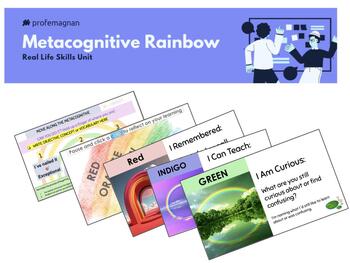
Metacognition, Retrieval & Reflection
Agarwal, P. K., Bain, P. M., & Chamberlain, R. W. (2012). The value of applied research: Retrieval practice improves classroom learning and recommendations from a teacher, a principal, and a scientist. Educational Psychology Review, 24, 437–448.
Dunlosky, J., Rawson, K. A., Marsh, E. J., Nathan, M. J., & Willingham, D. T. (2013). Improving students’ learning with effective learning techniques: Promising directions from cognitive and educational psychology. Psychological Science in the Public Interest, 14(1), 4–58. https://doi.org/10.1177/1529100612453266
Martelletti, D. M., Luzuriaga, M., & Furman, M. (2023). “What makes you say so?” Metacognition improves the sustained learning of inferential reading skills in English as a second language. Trends in Neuroscience and Education, 33, 100213.
Sur, E. (2025). The role of metacognitive strategies training in foreign language learning: A meta-analysis study. Journal of Ahmet Kelesoglu Education Faculty, 7(1), 1–13.
Zimmerman, B. J. (2002). Becoming a self-regulated learner: An overview. Theory Into Practice, 41(2), 64–70. https://doi.org/10.1207/s15430421tip4102_2