Relax Into Listening: How Ethnographic Interviews Build Empathy and Language Skills
The classroom fell silent as Brandon leaned in to complete his final ethnographic interview reflection.“I’ve heard the story before, but this time felt different. I noticed things about the story and myself I never noticed before. I realized I am afraid of being forgotten."
After he spoke, the entire class fell silent, until one student spoke out in Spanish, “Brandon, I’ll remember you.” A shiver ran through the room as one by one we agreed that we would remember him too. For that brief, silent exchange, we all felt the weight and courage of being truly heard. Listening has the power to transform, connect, and uncover our own fears and hopes.
In our classrooms, we often ask students to listen, but do we teach them how? Deep, empathic listening isn’t automatic; it’s a skill that requires practice. And in the language classroom, it may be one of the most powerful tools we have for building both fluency and humanity.
Nearly three decades ago, scholars Robinson-Stuart and Nocon (1996) challenged the practice of teaching static cultural facts in language classrooms. They advocated instead for ethnographic encounters, in which students become researchers of lived experience. When students engage in this kind of inquiry with openness, curiosity, and humility, they begin to move beyond stereotypes and form genuine human connections.
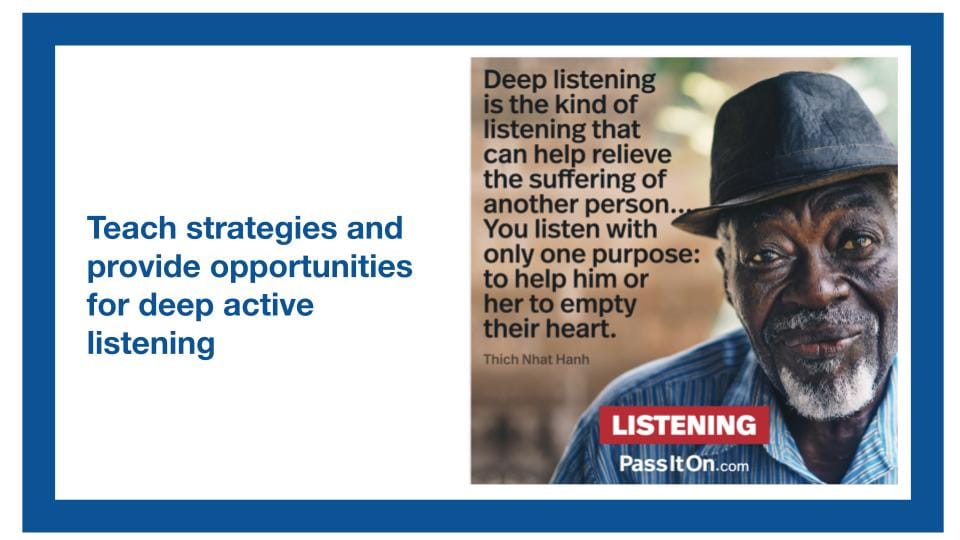
Meaningful learning often begins not with speaking, but with listening; deep, intentional listening that invites us to understand someone else’s world. When students listen not to judge, fix, or reply, but to understand, something shifts. They become more present, more receptive, and more capable of developing empathy, insight, and authentic language fluency.
Contemporary research confirms that this vision is not only possible but effective in today’s classrooms. One of the most transformative ways I’ve helped students experience this kind of connection is through ethnographic interviews: a practice rooted in anthropology that invites students to enter another person’s world through open-ended, compassionate storytelling.
Empathic listening has been shown to increase student trust, reduce behavioral issues, and foster a sense of relational belonging. Neuroscience echoes what ethnographers have long known: when we feel truly heard, our bodies shift from a stress response into a state of calm. When we slow down and attune to someone’s tone, gestures, and story, the body releases oxytocin, the hormone linked to trust and connection. We move from survival into safety, from sympathy into shared understanding.
Relaxation, Risk-Taking, and the Language Classroom
Creating a relaxed, supportive environment isn’t just a nice-to-have; it’s essential for learning, particularly in language classrooms. When students feel safe, seen, and unpressured, their affective filter, a concept introduced by linguist Stephen Krashen, lowers. This filter refers to emotional barriers like fear, low self-confidence, or anxiety that can block language acquisition.
Ethnographic interviews help dismantle those barriers. When students engage in meaningful, face-to-face conversations, their nervous systems shift from fight-or-flight to rest-and-digest. Deep listening supports regulation, trust, and connection: key conditions for language learning and risk-taking.
In other words, learning to truly listen doesn’t just build cultural competence; it’s grounded in neuroscience that creates the internal safety needed for language growth.
What Is an Ethnographic Interview?
Ethnography, rooted in anthropology, is a qualitative research method that uses close observation and open-ended interviews to understand others’ lived experiences. The goal isn’t to critique or correct, but to listen; to explore another person’s perspective and the cultural meanings behind it.
When the skills are taught and practiced in the classroom, ethnographic interviews allow students to step into someone else’s world. Whether interviewing a classmate, family member, or community member, students learn to elicit stories through curiosity and presence, not assumption or agenda.
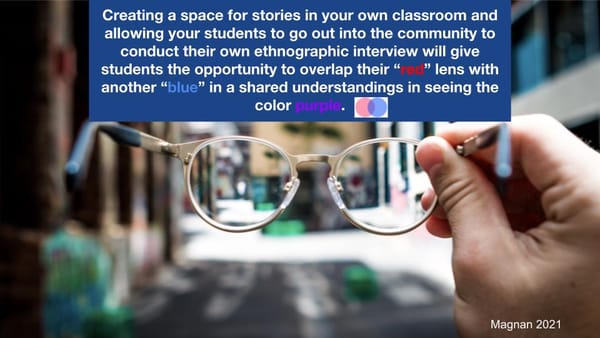
At its heart, this practice cultivates the ethnographic mindset, a stance rooted in inquiry, empathy, and humility. It teaches students that while we may come from different experiences and backgrounds, we often share the same deeply human emotions: fear, joy, grief, and hope. Connection begins to emerge in the spaces where our perspectives start to overlap in what I’ve come to know as sharing in the color purple: those pathways of shared understanding and meaning that open when we are simply present to one another.
Laying the Foundation: Active Listening Skills
Before diving into student interviews, begin by cultivating presence by starting with activities that highlight shared experiences. Research shows that mutual understanding can be achieved by first seeking similarities before the next step of identifying differences and arriving at cross-cultural perceptions.
Use playful, low-stakes routines that help students listen actively and interactively:
- “A mí también me gusta” ("Same here") game: Teacher posts or students share fun facts about themselves, and classmates signal by standing, raising a hand, or moving to a side of the room when they feel the same. This quick, affirming activity shows that we have more in common than we might assume.
- This or That?: Pose quick preference questions like “Netflix or YouTube?” or “Salty or sweet?” Students physically move or gesture in response, sparking spontaneous conversation and laughter.
- Four Corners: Label classroom corners with culturally relevant categories like foods, traditions, artists, or places featured in class content. Students choose a corner and share a personal memory or connection tied to their choice, bridging classroom content with lived experience.
Establish routines for partner conversations to encourage students to ask follow-up questions, rephrase what they heard, and stay curious. These small, consistent moments build listening stamina, relational trust, and the emotional groundwork for deeper ethnographic work.
The R.E.L.A.X. Strategy for Ethnographic Interviews
Before conducting their interviews, students need a mindset shift, away from performance and toward presence. I adapted Robinson´s strategy to help guide students´ mindset and behavior:
R – Regulate your body and breathTake a moment to ground yourself before the interview. Breathe deeply. Check your posture. A calm body helps create a calm mind and sets the tone for a more open, authentic exchange.
Why it matters: Reduces the affective filter and helps shift students from fight-or-flight into a parasympathetic state, increasing empathy and attentiveness.
E – Enter with Empathy and opennessLet go of assumptions. You’re not here to fix or evaluate. Be curious. Care about the outcome for your conversation partner as well as for yourself.
Classroom tip: Write a mantra on the board in the target language, such as “I’m here to understand, not to judge.”
L – Listen with your whole selfPractice full-body listening:
- Eye contact
- Open posture
- Nodding or mirroring
- Attentive facial expression
- Embracing silence that allows for reflection
Bonus technique: Pair students to silently mirror each other for 60 seconds to be fully present.
A – Accentuate the positive and Ask open-ended questions
The psychological tendencies that lead us to focus on the negative can be countered by intentionally emphasizing the positive. We can interrupt the autopilot that drives us to stereotype, blame, or dwell on shortcomings, and instead cultivate curiosity through open-ended inquiry. Avoid yes/no questions and try asking:
- “Can you tell me more about…?”
- “How did that experience shape you?”
- “What did that feel like?”
- “Is there anything you’d like to add?”
Let the speaker guide the story, allowing their perspective to unfold naturally.
X – Examine and Exit your own agendaResist the urge to respond with your own story. Instead, hold space for theirs.
Reflection prompt: “What surprised you about simply listening without adding your own thoughts?”
The RELAX framework supports authentic connection, especially across language and cultural differences.
Moving Deeper: Preparing for the Interview
Once students have built their listening muscles, introduce the structure of ethnographic interviews:
- Set the Purpose: The goal is not to impress or interrogate; it´s to understand someone’s story with respect.
- Teach the Tools: Students choose from strategies like:
- Asking open-ended questions
- Rephrasing: “So what I’m hearing is…”
- Observing body language and emotion
- Following up: “Tell me more about...”
- Model and Practice: Read interview transcripts, role-play conversations, and discuss how to create psychological safety.
- Create and Refine Questions: Have students draft interview guides around a “Grand Tour” theme (e.g., identity, daily life and routines, passions and inspirations, cultural traditions), then refine them through peer feedback.
The Power of Face-to-Face Connection
In an increasingly digital world, face-to-face conversations remain vital. Neuroscience tells us that mirror neurons help us feel what others feel by observing voice tone, gestures, and expressions.
As one student reflected:
“I didn’t realize how much I had in common with my interviewee. At the end of the day, despite where we come from, we all want to be loved, accepted, and heard.” — 9th-grade student, after interviewing a peer who had recently moved to the U.S.
Another shared: “The more I listened, the more I understood.” — 10th-grade student, after interviewing a school staff member
These connections, or what I have come to call the purple space, where two perspectives overlap, are at the heart of ethnographic work. This is the purple lens of empathy: a place where your story meets mine, and students discover that while circumstances may differ, core emotions often mirror their own.
Presence Over Perfection
Teaching students to listen deeply and ask thoughtful questions isn’t a one-day task: it’s a mindset and a daily practice. Start small. Begin with one piece: a daily partner prompt, a rephrasing routine, a silent mirroring exercise. Celebrate curiosity. Celebrate courage. And above all, celebrate presence.
Teaching ethnographic interviewing equips students with tools they can carry beyond the classroom into their families, communities, and even into another language. These skills invite them to step into another person’s story with curiosity and care.
At its core, this process helps students adopt the ethnographic mindset: a posture of inquiry, empathy, and humility. It teaches students that while we may come from different cultures and experiences, we can still share deeply human feelings and find connection in the “purple” space where two perspectives meet.
When we make space for stories in our classrooms, we’re not just nurturing better listeners or speakers; we’re cultivating more empathetic, curious, and fully human learners. And in today’s world, that may be the most important lesson of all.