How to Make Retrieval Routines a Classroom Habit: Edutopia Jam Session
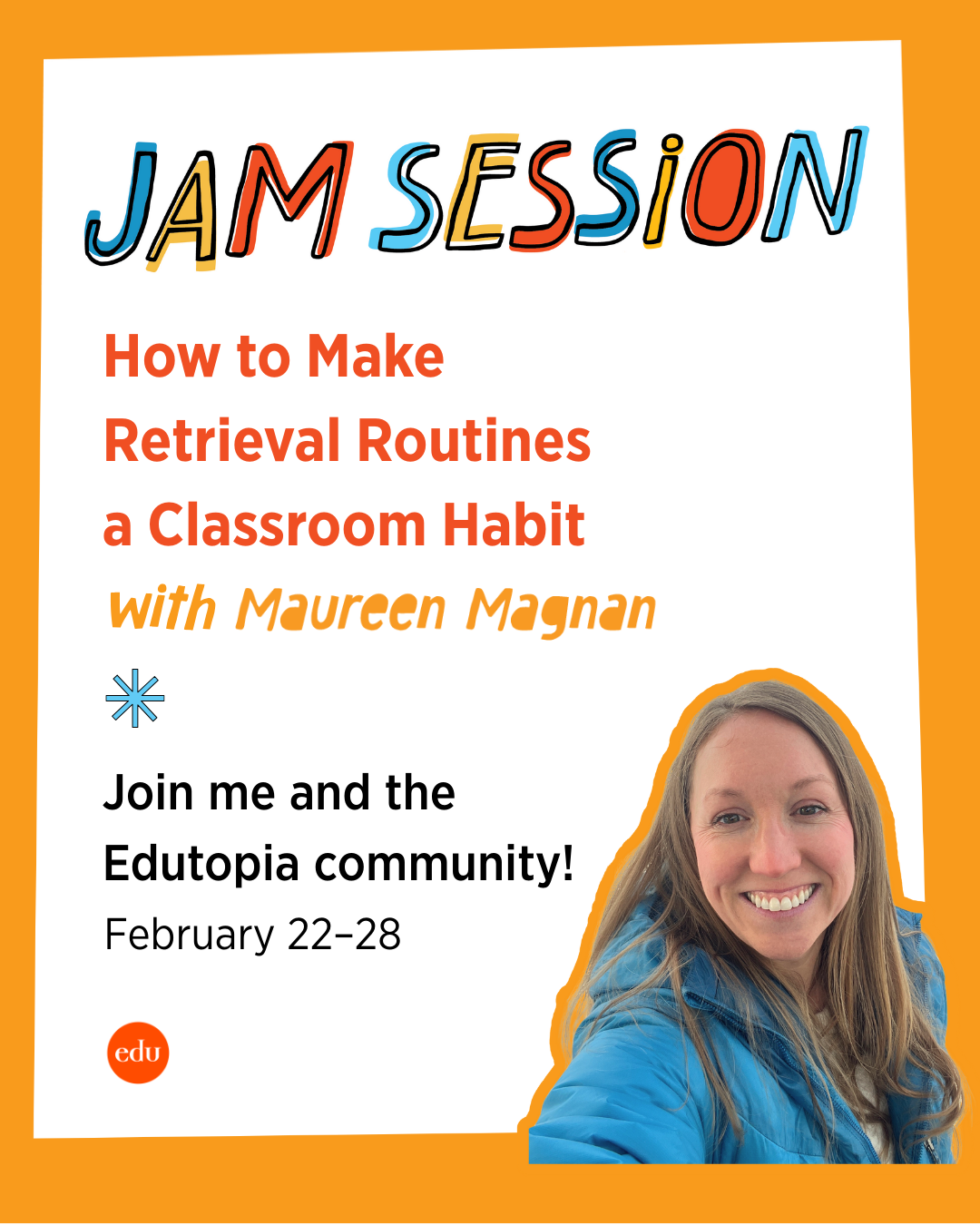
Stop treating retrieval practice as "one more thing." Join us and Maureen Magnan on Edutopia to explore low-prep strategies that make retrieval a natural, daily classroom routine.
Update: Edutopia Jam Session: Retrieval Practice
Update: The Jam Session is now closed, but the link is still live if you want to explore. I wanted to capture some of the key takeaways that really stood out from what the community shared so you can try them in your classroom too.
Retrieval Jam Session Take-Aways
Over the week, educators from around the globe jumped in with questions, strategies, and real classroom experiences. Here’s what rose to the top:
1. Retrieval practice is a learning strategy
I’ve learned so much about this from Powerful Teaching, and now I explicitly show my students how memory works. I like to use the example of a golden retriever fetching a stick. Just like the dog, our brains “retrieve” ideas, words, or concepts to strengthen them. Every time students recall information without notes, their learning sticks better. This mindset also lets me make mini-quizzes low-stakes, which reduces stress for students and honestly makes my life a little easier too!
2. The start and end of class is prime retrieval time
A simple, but powerful routine teachers shared is to pause at the beginning, or end of class, with no new content, and just have students pull out what they remember from a previous or current lesson. It’s predictable, repeatable, and works in any subject, making retrieval a natural part of the learning flow. My go-to activities are 2 things or a brain dump.
3. Buy-in comes from naming the “why”
Teachers who explain why we do retrieval see far less pushback. When students understand that forgetting is normal and that retrieval helps rebuild memory, they lean in rather than shut down. Naming the purpose gives them ownership of their learning.
4. Retrieval can reduce cognitive overload
Some teachers worry retrieval will overwhelm struggling students. Many found the opposite: when routines are predictable and low-stakes, students feel calmer and more confident because they know what to expect. The retrieval routine itself becomes a scaffold for learning rather than an extra challenge.
5. One routine done consistently beats five strategies done once
The clearest lesson from the week: consistency matters more than complexity. Teachers who built even a simple retrieval habit saw the biggest results.
Spacing and interleaving also improve long-term retention. Giving students multiple opportunities to retrieve and apply ideas over time helps knowledge stick. Interleaving, mixing related topics or problems, helps students see connections and apply learning more flexibly. In my classroom, I’ve built spacing and interleaving into mini-retrievals and Stop & Jot activities spread across the week rather than cramming everything into one lesson. This is when I started using a weekly worksheet structure to remind myself to have students retrieve.
Honestly, one of the simplest ideas is how a small, consistent pause after new learning can make a huge difference. Small, intentional routines beat big overhauls every time. Check out more on the Power of the Pause and this new Edutopia article on Stop & Jot videos.
My favorite resource shares:
- Strategies for using flashcards more effectively
- Sister M. created this graphic she created to help students use flashcards more effectively.
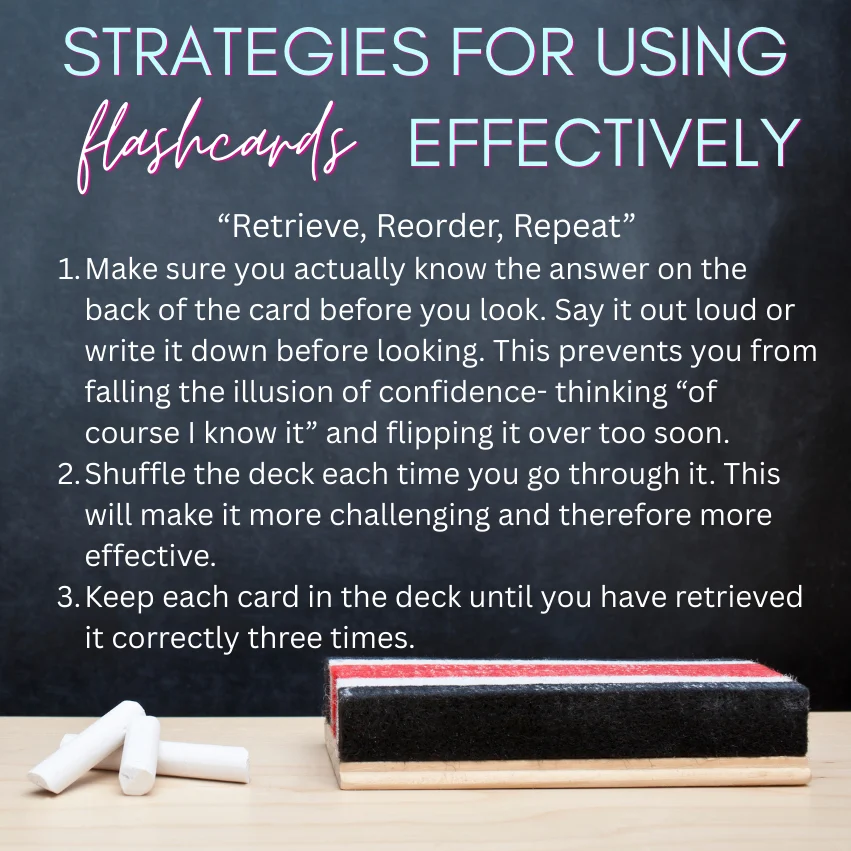
- “What Will Improve a Student’s Memory?” – Daniel T. Willingham
- In this article, cognitive scientist Daniel T. Willingham explains how memory works and what actually helps students retain learning. At its core, memory is the “residue of thought” — meaning we remember what we think about deeply, not simply what we review passively. Willingham describes three principles that matter for classroom learning:
- Memory formation depends on attention and meaningful thinking, not just repetition or exposure.
- Retrieval cues are crucial — forgetting often happens because we lack good cues, not because the information is gone.
- Students often overestimate how well they know something, so instructional strategies should help them assess their knowledge more realistically.
- In this article, cognitive scientist Daniel T. Willingham explains how memory works and what actually helps students retain learning. At its core, memory is the “residue of thought” — meaning we remember what we think about deeply, not simply what we review passively. Willingham describes three principles that matter for classroom learning:
He translates these cognitive principles into classroom strategies that encourage active thinking and retrieval, rather than passive study habits like rereading, which feel productive but don’t lead to strong memory.
📄Read more here from the article Rob shared an article crucial for any student looking to be a better studier! https://drive.google.com/file/d/1cnjIJorSjvnWcO5_icllSenuiJze-tej/view
https://www.aft.org/sites/default/files/willingham_0.pdf
- 🧬 “The Lethal Mutation of Retrieval” – Carl Hendrick
Another thoughtful piece on retrieval explores how the strategy can be misunderstood or misapplied in practice. Carl Hendrick reframes retrieval not as a trick or standalone task, but as a core part of how learning becomes durable when it is intentionally connected to meaning, spacing, and transfer.
The article digs into common pitfalls, like using retrieval as busywork or disconnected questions, and offers guidance on making retrieval lethal to forgetting by anchoring it in thoughtfully designed instruction that reinforces true understanding across time.
📄 Read it here: https://carlhendrick.substack.com/p/the-lethal-mutation-of-retrieval?ref=profemagnan.com
- Optimize learning from middle school to college from Cognitive Psychology
- Organize your time
- Find a quiet place to study
- Prepare before for each class
- Answer comprehension questions before you read the assignment
- Generate questions about important points
- Read, recite, and review
- Attend class!
- Leave your laptop in your backpack and write your notes instead of typing them
- Turn off your phone
- After class, synthesize
- Study a little bit every day
- Study by quizzing yourself
- Space out your learning
- Learn by testing yourself (write down what you remember after you read, flash cards, recall multiple times before taking the card out of the deck)
- Be skeptical about wha tyou think you know
📄Read more here from the article Rob M. shared about what is crucial for any student looking to be a better studier! https://drive.google.com/file/d/1cnjIJorSjvnWcO5_icllSenuiJze-tej/view

You are invited to the February 2026 Jam Session: How to Make Retrieval Routines a Classroom Habit, where educators from around the globe are asking questions, sharing strategies, and building on the science of learning to make retrieval practice a natural part of daily teaching. In this week-long conversation, educators can explore how Retrieval Practice can move from an occasional strategy to a consistent part of classroom life. Throughout the week, teachers and instructional leaders will share questions, ideas, and real classroom experiences as we think together about sustainable Classroom Habits that support learning.
Join the Jam Session on Edutopia here
In many classrooms, the challenge isn’t knowing that retrieval works, it’s making it practical. Thoughtful routines can lower cognitive load, strengthen memory, and create more opportunities for students to feel successful. This jam session focuses on small, repeatable moves that help retrieval feel natural rather than like “one more thing.”
Why Retrieval Routines Matter
Retrieval routines help students revisit and strengthen learning over time, making knowledge more durable and transferable. When retrieval becomes predictable and low-stakes, students build confidence alongside competence, and teachers gain clearer insight into what students truly understand.
Equally important, routines create consistency. Instead of relying on one-off activities, classrooms can develop shared expectations around thinking, remembering, and reflecting: habits that support attention, engagement, and deeper learning across content areas.
Ultimately, our goal is simple: translate learning science into classroom practice in ways that are doable, flexible, and supportive of both teachers and students.
What to Expect
Participants will explore questions such as:
- How can retrieval become a quick, predictable start-of-class routine?
- What low-prep strategies make retrieval sustainable week after week?
- How can retrieval support attention and reduce cognitive overload?
- What does student buy-in look like, and how do we build it?
- How can teachers adapt routines across grade levels and subjects?
Event Details
- Dates: February 22–28, 2026
- Co-host: Maureen Magnan
- Platform: Edutopia
Direct Link to the Jam: https://www.edutopia.org/ask-and-answer/february-2026-jam-session-how-to-make-retrieval-routines-a-classroom-habit