Universally Designing for Attention: A UDL and Cognitive Load Strategy for the Real Classroom
Spring, seniors, and 80 minutes to fill — here's what I learned about designing for attention using UDL and the science of cognitive load.
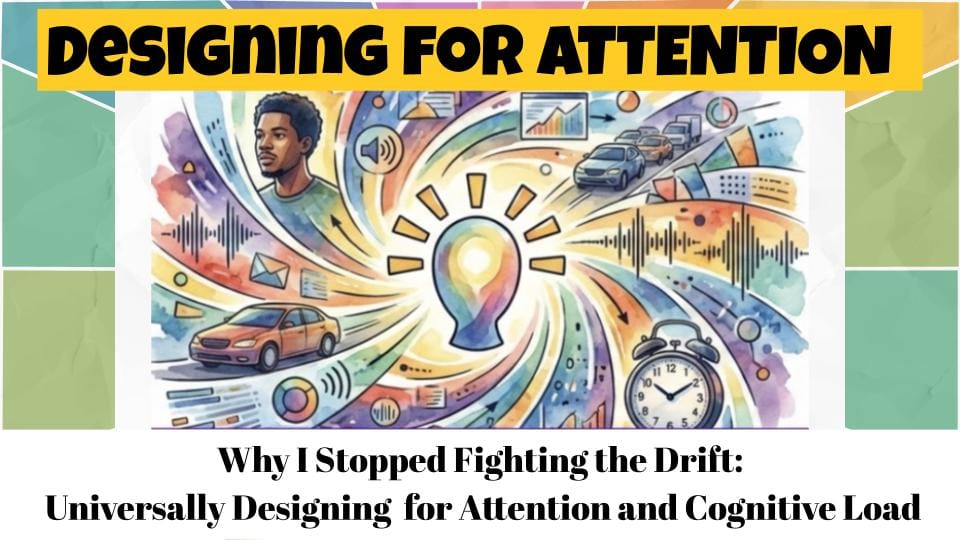
Twenty-five faces, April light splashing across the desks, and somewhere around my third slide, I lost half of them. Spring is thick in the air, graduation looms, and as my juniors and seniors sit before me, I catch myself wondering: Can I really hold their attention for 80 minutes right now?
Full transparency: part of the reason I keep writing about this is that I’m still figuring it out myself.
Staying present when life feels like it's tilting toward something new is a tension I know well. My to-do list drones in the background, my kids volley questions all at once, and by the end of the day, I often find myself staring blankly at my phone to escape my own cognitive overload.
This post explores what I’m learning about the science of attention and how I’ve started designing for it using Universal Design for Learning (UDL), building on ideas I recently shared in Edutopia on Designing Learning for Attention. What surprised me: these strategies have been just as useful in my everyday adult life as in my classroom.
The efficiency trap I fell into (and maybe you have too)
Honestly, I am guilty of everything I'm about to describe.
For a while, I listened to nearly every podcast and audiobook at 1.5x speed. Sometimes 2x. I felt productive as I was racing through books and ideas as if I could swallow knowledge whole. I remember driving home one October afternoon, three chapters deep into an audiobook, and could not name even one character. Research tells us what I had already experienced: when you compress input, you eliminate the pauses; the moments where the brain quietly connects, questions, and consolidates. When I sped everything up, I consumed a lot... and retained surprisingly little.
The same logic applies to multitasking. Research consistently shows that people who frequently switch between multiple media streams tend to have lower cognitive control, more difficulty filtering out irrelevant information, and higher error rates, even while reporting that they feel productive! (Ophir, Nass & Wagner, 2009). A landmark Stanford study found that heavy media multitaskers were actually worse at task-switching than their peers, despite practicing it constantly. In short, dividing attention doesn't build attentional strength; it fragments it.
So...that doom scroll I do at the end of the day? I'm just reinforcing the very habit I'm trying to recover from.
It's no wonder, then, that educators feel mounting pressure around student focus. The problem isn't that students can't pay attention; it's that the kind of attention school often demands is increasingly out of sync with what students, and adults (myself), are being trained to practice every day. When it comes to learning, efficiency often backfires.
What attention actually is (and isn't)
The 'attention span' framing we've inherited, the idea that every person has some fixed number of minutes they can focus, was never accurate to begin with.
Attention depends heavily on working memory (holding and manipulating information). It is basically the sticky note your brain uses to hold an idea just long enough to do something with it, like remember a phone number long enough to dial it, or keep track of ideas while writing a paragraph.
Active information decays fast, new input stops going deep, and you can hear every word without encoding a single one.
Researcher Carl Hendrick reminds us that visible engagement and actual learning aren't the same thing. A student can look checked out and still be processing, while another can look attentive and retain nothing (Hendrick, 2026).
This helps explain a common student experience: “I was listening, but I didn’t get it.” When too much information comes in, working memory becomes overloaded. The brain responds by disengaging as a form of regulation.
In that sense, drift is often a signal: this is too much, too fast.
Why Attention Breaks Down
What's especially important for teachers to understand is that attention isn't one thing.
Selective attention reaches near-adult levels by early adolescence. Sustained vigilance, the kind required to stay focused during a long lecture, continues developing into young adulthood (Rueda, 2018).
Which means asking a 17-year-old to maintain uninterrupted focus during a 45-minute lecture may be developmentally mismatched, regardless of motivation.
At the same time, our environments are shaping how attention behaves.
Psychologist Gloria Mark’s research shows a steady decline in how long people stay on a single screen task:
- ~2.5 minutes in 2004
- ~75 seconds in 2012
- ~47 seconds more recently (Mark, 2023)
It's worth being precise about what that number means, and doesn't mean. The 47 seconds measures how long people stay on a single screen task before switching to another in digital environments. Mark herself is clear that this isn't a measure of our capacity for deep attention. It's a measure of what we're actually doing with it. It means the problem is behavioral. Our brains didn't change, but our habits sure did.
That desperate pull to multitask or fragment my attention with my phone or a million tasks during my prep period isn't a weakness; it’s a trained response, reinforced over time.
It's learned behavior. Which means that restlessness we feel in April isn't senioritis or apathy. It's a pattern, and patterns can be redesigned.
When we stop fighting the drift
Attention is not just cognitive, it's emotional. We attend to what feels relevant, meaningful, or rewarding. The brain’s dopamine system plays a role in sustaining focus. Work by Mihaly Csikszentmihalyi shows that attention sustains when challenge and skill are balanced
- Too easy → boredom → drift
- Too hard → anxiety → drift
At the same time, attention is shaped by what we repeatedly practice. When students spend long stretches in passive, uninterrupted instruction, we may actually be reinforcing the fragmented attention we’re trying to fix. In a sense, we’re training students in the very habits that frustrate us.
That realization pushed me to try something different.
Not all drifting is negative. In fact, research on mind-wandering suggests it can support creativity, problem-solving, and even the consolidation of learning. It allows space for reflection and identity-building. The difference lies in how that drift is structured:
- Unintentional drift → lost learning
- Structured reflection time → deeper learning
Instead of fighting the drift, I started working with it through retrieval pauses, a form of retrieval practice, brief moments where students stopped, reflected, and actively recalled what they had just learned. I share more about how I redesigned these lessons here: Designing Instruction That Accounts for Student Attention.
What I found is that attention is trainable. The brain adapts to the patterns of engagement it experiences most. Environments that reward rapid switching reinforce rapid attention. Environments that support sustained focus help build it. It´s learned behavior.
That shift led me to rethink my core question. Instead of asking, what's wrong with my students' attention? I started asking how do I design for sustained attention?
Designing for attention with UDL
Students pay attention to what they value. When learning feels purposeful and within reach, engagement increases. Autonomy, choice, and meaningful goals all support sustained attention.
This is where Universal Design for Learning (UDL) helped me reframe my practice.
The strategies I began using, such as retrieval pauses, movement resets, and a two-phase lesson structure, are not just intuitive. They are supported by research.
A 2025 study in Frontiers in Psychology found that students who experienced frequent micro-breaks not only outperformed those who didn’t, but also maintained more consistent performance over time. The researchers describe attention lapses as “inevitable consequences of our adaptive cognitive design,” signals that the brain needs periodic disengagement to function well (Sharpe et al., 2025).
Similarly, even brief rest breaks before cognitively demanding tasks improve subsequent learning (Deyoe et al., 2023).
The retrieval piece is equally critical. Over a century of research shows that actively recalling information strengthens retention far more than passive review (Agarwal, Nunes, & Blunt, 2021). What I initially thought of as a pause was actually doing double duty: restoring attention and consolidating learning.
I saw this play out in real time. During a video in class, I asked my student, Matteo, for feedback. He suggested I pause the video and have students write a sentence to summarize what they had just seen. What Matteo described was UDL in practice.
From a UDL perspective, these retrieval pauses provide multiple means of engagement. They support self-regulation, reduce cognitive overload, and honor the natural rhythms of attention, without lowering expectations.
The Attention takeaway
Today I paused the video for 30 seconds, provided a sentence starter, and asked everyone to write a recommendation for the protagonist, and share with a partner. This time, I watched twenty-two pencils move at once. April light, same room, very different thirty seconds.
I realized my students didn’t need to be pushed to endure longer stretches of cognitive strain without support. They needed an environment that gives attention somewhere worth going, and structures that help them get there. This is UDL in action as I pause to reflect lesson by lesson, April by April.
May your lesson planning reduce your cognitive load, invite attention in, and make micro-spaces for it to stay!
For the practical classroom strategies behind this post, the two-phase lesson structure, the movement resets, and more, head over to my recent piece on Edutopia.
References and Sources
Agarwal, P. K., Nunes, L. D., & Blunt, J. R. (2021). Retrieval practice consistently benefits student learning: A systematic review of applied research in schools and classrooms. Educational Psychology Review, 33, 1409–1453.
Hendrick, C. (2026, March). The Monthly Dispatch: What's new in learning science? The Learning Dispatch [Substack]. https://carlhendrick.substack.com/p/the-monthly-dispatch-whats-new-in-f3c
Deyoe, M. M., et al. (2023). Rest breaks aid directed attention and learning. Educational & Developmental Psychologist, 40(2), 141–150. https://doi.org/10.1080/20590776.2023.2225700
Mark, G. (2023). Attention Span: A Groundbreaking Way to Restore Balance, Happiness and Productivity. Hanover Square Press.
Ophir, E., Nass, C., & Wagner, A. D. (2009). Cognitive control in media multitaskers. Proceedings of the National Academy of Sciences, 106(37), 15583–15587. https://doi.org/10.1073/pnas.0903620106
Rueda, M. R. (2018). Attention in the context of learning and development. In Stevens' Handbook of Experimental Psychology and Cognitive Neuroscience. Wiley.
Sharpe, B. T., et al. (2025). Sustaining student concentration: the effectiveness of micro-breaks in a classroom setting. Frontiers in Psychology. https://doi.org/10.3389/fpsyg.2025.1589411
Magnan, M. (2026). Designing instruction that accounts for student attention. Edutopia. https://www.edutopia.org/article/designing-instruction-student-attention