Write & Discuss: Reduce Cognitive Load Through Co-Created Text and UDL
After watching the same three students contribute every time, I rebuilt Write & Discuss from the ground up. Here's the step-by-step routine—rooted in UDL and cognitive load research—that finally got my entire class co-creating text together.
A love letter to co-created texts and how rocky the road was to get there.
I stood at the front of the room, colorful markers in hand, brimming with professional development energy. I had just learned about Write & Discuss at a conference, experienced it on Zoom, dove into every blog post, and was ready to give it my best shot.
Near the end of the lesson, I prepped the students to summarize the lesson and started with one word, smiled encouragingly, and waited for students to contribute the next word...
The same three students shared, while the rest quietly copied what I wrote on the board. I avoided cold-calling, but I couldn't find a way to get the students sitting quietly in the back to participate genuinely. I'd later learn that it was a participation problem caused by cognitive load on an unprepared speaker, but I didn't know that yet.
I love the idea of Write & Discuss. I first discovered it through Mike Peto's work, then Señora Chase's blog. At its core, students see their thinking become real sentences on the board. Together, you brainstorm transition words, shape the flow, and revisit key vocabulary and concepts from the lesson, solidifying the objective in the process.
It’s collaborative: students recognize their thinking in print (and can even see their names in the text, e.g., “Jack thinks…”). It’s joyful, and it works.
But the execution? That took me a while, and it’s still a work in progress...and then there was the student who called me out in a weekly reflection. (More on that in a moment.)
Wait, what even is Write & Discuss?
If you're new here, or to this routine, here's the short version: Write & Discuss is a whole-class, co-constructed writing routine that can be done mid-lesson or as a summary at the end. It is where you and your students together build a short text, usually 5–8 sentences, based on a shared experience, such as a story, video, conversation, image, reading, or lesson.
The teacher acts as the scribe, either by writing on the board to expose students to handwriting or by pulling up a Google Slide or document to project the writing. Students contribute ideas, and together, you shape the language, adding transitions, varying sentence starters, and building toward a real piece of writing that the entire class helped create.
What’s powerful is that this routine naturally differentiates without needing separate materials or tracks.
- Students can contribute at their level: a single word, a phrase, or a more complex sentence.
- You can recast and elevate language in real time, giving everyone access to richer structures without putting anyone on the spot.
- Some students extend ideas; others participate in ways that feel safe and manageable.
At the same time, it aligns seamlessly with Universal Design for Learning (UDL):
- Multiple means of engagement: Students co-create something meaningful from a shared experience, which instantly increases investment. It is fun, and often funny, when used to build classroom community. For example, when I build stories using student ideas, we learn about each other, and those same details often reappear in mini-quizzes the next day, making everything feel connected.
- For example, during the Atomic Habits unit I did with 12th graders, we learned about Joumana and Charlie’s goals and gave them advice on how to eliminate distractions while studying and stay motivated to wake up earlier. The following day, I used their ideas in a true/false quiz about their goals.
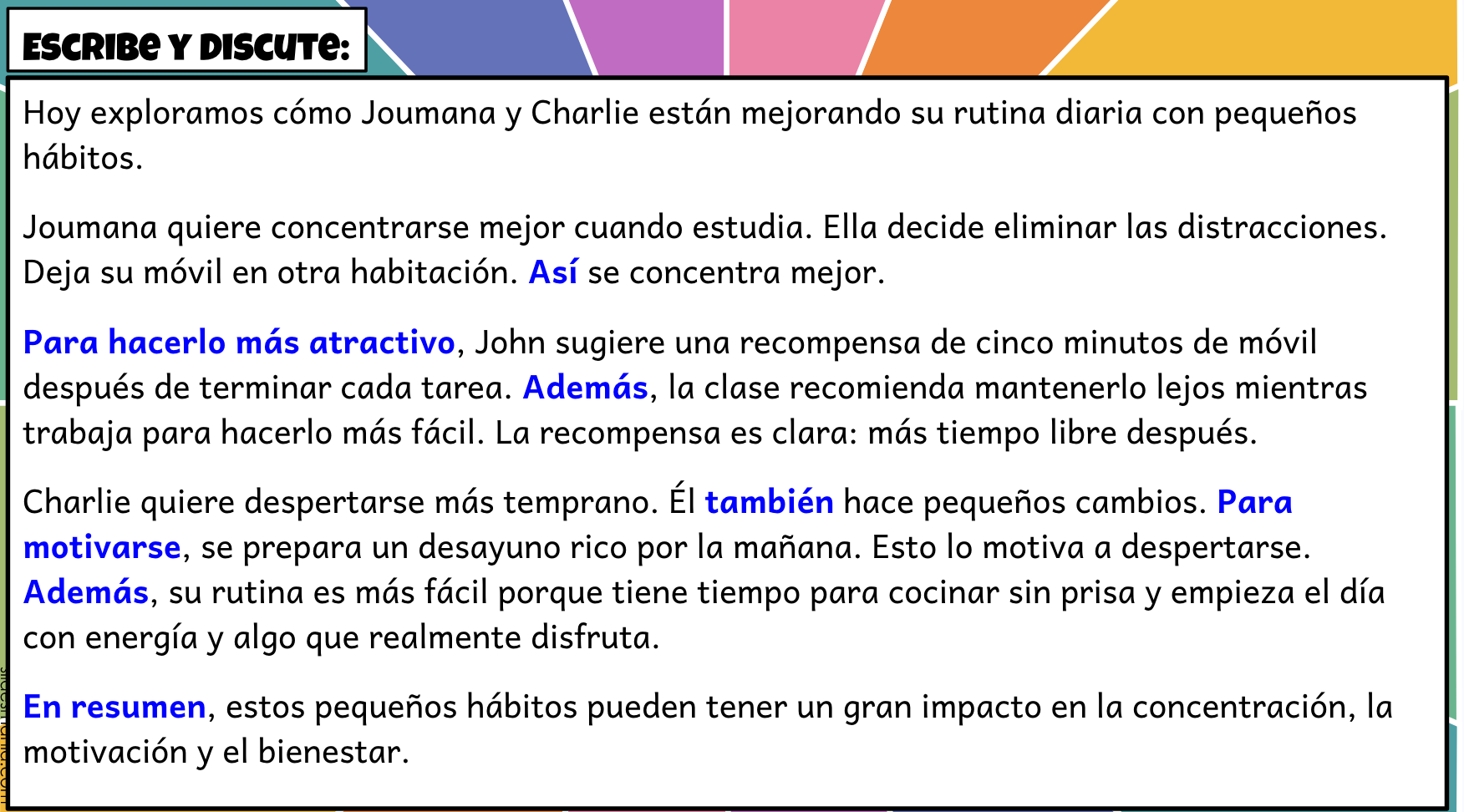
- Multiple means of representation: Ideas are heard, spoken, and then visually represented as a written text in real time. I learned from La Maestra Loca's podcast that she learned from Meg Fandel Vernon at a conference about the impact of handwriting and of using different colors for each sentence to support students in writing at their own pace.
- I’ve since built on that idea by highlighting key structures in blue and bolding transition words as we write. I also have students actively identify and annotate these features as we co-construct the text.
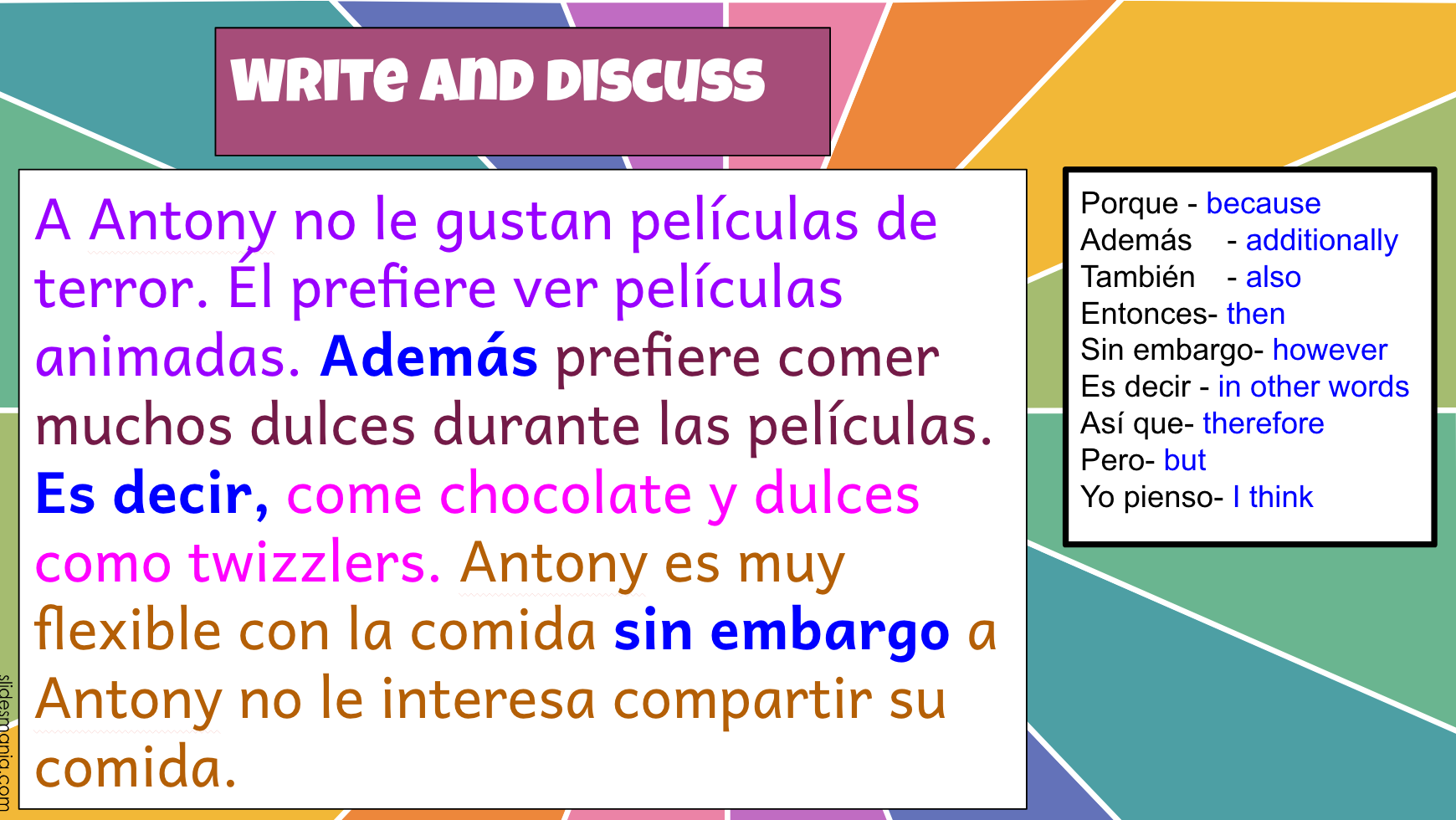
- Multiple means of expression: Students can participate orally, suggest edits, notice patterns, or later demonstrate understanding through low-stakes retrieval activities.
I often follow this immediately with a flip-and-recall: students turn their paper over and write everything they remember. The text doesn’t disappear after class; it becomes the basis for retrieval the next day: brain dumps, true/false, find the lie, fill-in-the-blank, “who said it?”, or matching sentence stems.
I tend to use it after a charla, but it also works after a video, Picture Talk, reading, or even mid-lesson as a check-in. Its flexibility is what makes it powerful; you can stretch it into a 15-minute routine or compress it into a single sentence. It bends to what the class needs.
Experience it as a Novice Learner
After discovering this routine through Mike Peto's blog and book, I experienced it when I took an Express Fluency beginner French class with the incredible Sophie Forker.
This time, I was the struggling learner; the one who got lost mid-lesson and needed Write & Discuss at the end to catch up on the French I had missed. It was written on our shared document so I could revisit it, figure out what I had missed, and process the language at my own pace.
It made me realize how Write & Discuss can connect and appropriately challenge every learner. For me, it was a lifeline that kept me in the game. But for more advanced students, it was something else entirely: a chance to slow down and notice nuances in the language they might otherwise have raced past. It naturally differentiated both the language and the lesson for us. And thank goodness we came back to it the following week, because I had forgotten. Seeing it again helped me retrieve the language and made it stick.
I left my French class feeling inspired to dive into Write and Discuss with my own classes; however, I was overwhelmed by the idea of fitting it in at the end of every day, despite knowing it works. So I started small by doing it weekly, with a dedicated space on my Para Empezar worksheet.
I kept running into the same wall of wanting organic participation, avoiding cold calling, and watching the quiet students politely opt out. So, I finally asked my students, "hey, how can I make the Write and Discuss better for you?" and that's where Joe called me out. "Profe, you give us a sentence starter and yeah, we contribute, but then we end up just copying what you write without us doing the thinking." Bam, he was right. I knew I was having trouble sitting in the silence, waiting for the responses to come, and got too excited to get them to think. So there it was, I needed a better system.
How I Redesigned Write & Discuss for Full-Class Participation (Step by Step)
- Start with a Compelling Charla Question
For example, during our Atomic Habits unit, I asked:
What habit would you like to change in your life?
I modeled it first with a photo of my cell phone next to my bed, another one of my new gym shoes, and a box of chocolate chip cookies. Students had to guess which habit I was trying to change and justify their reasoning. They were passionate about being right.
- Individual write — low stakes, high support
Students answered independently on their Para Empezar sheet, using sentence starters displayed on the board. I played light background music and stopped when the song ended. There was no pressure to be perfect, just a chance for everyone to form an idea before we began sharing out loud.
- Turn & talk, then turn & talk again
Students first shared with a partner, then two pairs combined into a group of four.
Their job was to choose the most compelling sentence from the group to share with the class. They were no longer sharing their idea. They were sharing the group’s idea.
- Group share-out
I circulated and asked each group to share the sentence they chose together. By this point, the idea had been written, said, heard, and agreed upon, so everyone was ready. We added sentences to the board and co-constructed: a strong starter, transitions, added detail, and richer language.
- Read, retrieve, reflect
Students re-read the text to track meaning, notice language, and recognize their own thinking in print. Then I had students flip it over and retrieve as much as they remembered, either verbally or in writing.
What to do with the text the next day
Since students helped make it, they actually remembered it, and every retrieval activity landed differently than it would with a textbook passage.
◆True/false or "find the lie": Use students’ names and details from their own sentences (“Cam wants to add running to his daily routine. True or false?”). I often follow this with a quick true/false mini-quiz using class-generated ideas (e.g., “Profe’s new habit is stopping after one cookie and savoring every bite”). Students can respond with a thumbs up/down, on a whiteboard, or in writing.
◆Fill in the missing word or match sentence stems.
◆Illustrate it: Offer a choice between drawing and answering comprehension questions.
◆Level it up: Add transition words and connector phrases, change the tense, or do Mad Libs-style rewrites with new characters and adjectives.
What matters most is choosing what fits your students and your goals. There isn’t just one “right” version of this.
Why this works
By building in private thinking time, multiple rehearsals, and collective decision-making, everyone can contribute. Multilingual learners are able to share ideas first and refine language afterward, while students who are usually quiet arrive at the conversation already prepared. Most importantly, it reduces cognitive load for all learners while reinforcing and consolidating the lesson’s objectives.
Research supports this approach, including findings that retrieval practice strengthens long-term memory more than re-exposure, repeated meaningful input reduces cognitive load for multilingual learners, and social rehearsal increases language production. In addition, UDL supports variability by design rather than accommodation, and co-constructed texts increase both engagement and accuracy.
Write & Discuss is a Shared Climb
For me, it is no longer a performance by a few confident students. Everyone starts with a solid footing, rehearses, and contributes. And no one gets left behind at the bottom, wondering when the lesson was going to include them.
If you've been curious about this routine and are not sure where to start, begin with one question, one slightly embarrassing photo of yourself, and a class full of students who are more opinionated about your chocolate chip cookie habit than you're prepared for. Start there. The rest will evolve faster than you expect.
FAQ
Q: What if students don’t want to share out?
A: They’re not sharing their idea, they’re sharing the group’s choice - less pressure and more buy-in.
Q: Do you correct everything?
A: Of course not, I focus on meaning first, we talk it out, then write out the stronger forms. It's collaborative, not corrective.
Q: Is this still rigorous?
A: Absolutely. The rigor is in the thinking, sequencing, and language expansion, not speed or isolation.
Q: How long does this take?
A: 5-15 minutes, depending on depth. It’s so flexible. You can even do a one-sentence version: "Summarize today's lesson in one sentence." Done.
Q: Can beginners do this?
A: Especially beginners. Sentence starters + repetition = confidence.
Q: What if only one group has a “good” sentence?
A: Every sentence is usable. My job is to help elevate it.
Q: Is this a formative assessment?
A: Yes! And it tells me far more than an exit ticket ever could and reinforces the lesson for all!
Let me know if you give it a try. Write & Discuss away! ✏️✨