When Good Enough Is Good Enough
A science-of-learning reflection on perfectionism, retrieval practice, self-compassion, and ending the school year well.
A science-of-learning reflection.
By the end of the school year, we often have a vivid memory of the lesson or student interaction that belly-flopped and a much fuzzier memory of the hundreds that succeeded.
One of the sessions for the Good Life for Educators course I taught this past semester dove into the downfalls of perfectionism and what is "good enough" in teaching...and life. And the more I explored the science behind it, the more I discovered the wisdom behind good enough in education and that tightrope balance: letting go of perfection while still striving to be our best selves for our students, our families, and ourselves.
The Science Behind Letting Go of Perfect
Two researchers working in very different fields arrived at remarkably similar conclusions: human flourishing does not require perfection.
In the 1950s, Nobel Prize-winning economist and psychologist Herbert Simon introduced a concept called satisficing, which really is a blend of the words satisfy and suffice. He argued that because our time, energy, and information are limited, we rarely optimize for perfection. Instead, we make the best decision we can with what we have and move forward. Simon called this bounded rationality, or a human response to the reality of complexity.
Around that same time, pediatrician Donald Winnicott introduced the concept of ‘good enough’ in the parenting world. He argued that no child needs a perfect parent, but rather a decent, good-intentioned, sometimes grumpy one who loves them through mistakes on both sides.
Like psychology and parenting, education is deeply human work. It unfolds through relationships, uncertainty, and countless daily decisions made with limited time, energy, and information. Every day, educators address standards, communicate with families, provide detailed feedback, document interventions, answer emails, meet social and emotional needs, and plan lessons with clear goals and flexible pathways for every student.
Although I may strive to design an amazing lesson, no matter how "perfect" the plan, if a student asks to go to the bathroom with tears in their eyes, I will throw that lesson out the window and check on that student.
Most of us know perfection is impossible, yet the push towards it shapes what we notice and remember. It becomes easier to see and recall what is unfinished than what is going well.
What Perfectionism Actually Costs Us
Dr. Kristin Neff, a pioneering researcher at the University of Texas at Austin and one of the leading voices on self-compassion, has spent decades studying what happens to people who hold themselves to impossible standards. Her research, and the work she developed alongside Dr. Christopher Germer in their Mindful Self-Compassion program, says something educators need to hear:
Self-critical perfectionism is one of the strongest predictors of burnout.
The teachers most at risk of burning out are often the ones who care the most.
Research consistently shows that self-compassion, or the practice of treating yourself with the same kindness you would offer a struggling colleague, is a measurable, evidence-based antidote to burnout. People who practice self-compassion experience less emotional exhaustion, recover more effectively from hard days, and are actually more able to show up sustainably for the people they care about and let go of the rest.
Recently, I practiced letting go when I had a carefully planned activity meticulously ready to go - materials cut out, instructions prepared, and everything organized. Then, Quinn and Jules brought up their amazing recent trip to Peru and took the lesson in a way more interesting and meaningful direction.
I set aside the activity I had invested effort into creating, and what followed was one of my favorite discussions all year. Seriously though, nothing could have topped their story of hiking Machu Picchu, helping build a retaining wall, playing soccer with Peruvian children, negotiating meaning while buying silver rings, and an entire plane of students getting sick on the flight home after eating the salad. We were captivated.
It was a reminder that some of the best moments in teaching happen when we are willing to pivot and trust the learning unfolding in front of us. When we are overly attached to getting everything "right," it becomes harder to let go of our plans, even when something richer emerges. Educator-compassion is what allows us to release control when learning takes us somewhere better than we planned.
What Students Remember
One of my favorite classroom traditions started by accident.
In the classroom and at home, I’m known for having “butter fingers.” For the life of me, I can’t open a pickle jar, and things slide out of my hands with surprising regularity: stacks of papers, dry erase markers, water bottles, my tea — you name it. Despite my best efforts, I still trip over backpack straps, knock things over, and occasionally create minor classroom chaos.
Those same slips sometimes show up in my lesson slides, where excited creation meets missed errors that my students notice immediately.
Years ago, these moments embarrassed me even if I knew it was a positive for students to see that I can laugh at myself through bright red cheeks and my face hidden in my hands.
So I stopped trying to appear flawless and created a classroom tradition that turned my mistakes into a celebration.
I converted it into a game: whenever students find a mistake in my slides, worksheets, or instructions, I celebrate their careful reading with an extra point added to any grade where they need it, pound and/or, a high-five.
It is now my favorite when I see a quieter students' eyes light up to tell me they found an error or something else I screwed up on. It feels good when I can return the smile and reward them with an extra point and a pound for catching it. I even sometimes sneak a silly mistake in on purpose.
The unintended result has been wonderful: students pay closer attention, read directions more carefully, and learn that mistakes are not something to hide.
A student once told me, “I like this class because you don’t act like you know everything.” I think that was one of the nicest compliments I got all year.
Moments like that are a reminder that imperfection can be wonderful. Students rarely remember whether every lesson was perfectly designed or every worksheet was error-free. What they seem to remember is whether they felt safe enough to learn, take risks, and be themselves.
This year, I hope to extend the teacher playfulness with some borrowed ideas from Claire English and the Unteachables community. I adapted her end of the year slides in Spanish and a few of my favorites were:
“What classroom rule is your teacher weirdly obsessed with?”
“Your teacher deserves a vacation after dealing with…”
“What would instantly ruin your teacher’s summer break?”
“You see your teacher on a Saturday morning. What is she buying?”
Finally, one of the healthiest things a teacher can do is leave school at the end of the day and not carry every imperfection home. As Neff and Germer remind me, I am choosing to be a "compassionate mess" rather than an exhausted perfectionist.
The Good Enough Retrieval for Teachers
One of the ironies of teaching is that we spend our careers helping students understand how learning works, while forgetting that the same principles apply to us.
At the end of the school year, many of us perform a mental review of the year. The problem is that we rarely do it accurately. Most likely you will remember what is most emotionally salient or unresolved, and those can often be the mistakes: the lesson that failed, the difficult meeting, the student we could not seem to reach, the email we forgot to answer, or the time we said the wrong thing to a student or colleague.
What comes to mind first though is not always the most representative evidence. It is simply what is most easily retrieved. So, before you leave for summer, try a small retrieval exercise without opening your planner, gradebook, photos, or notes.
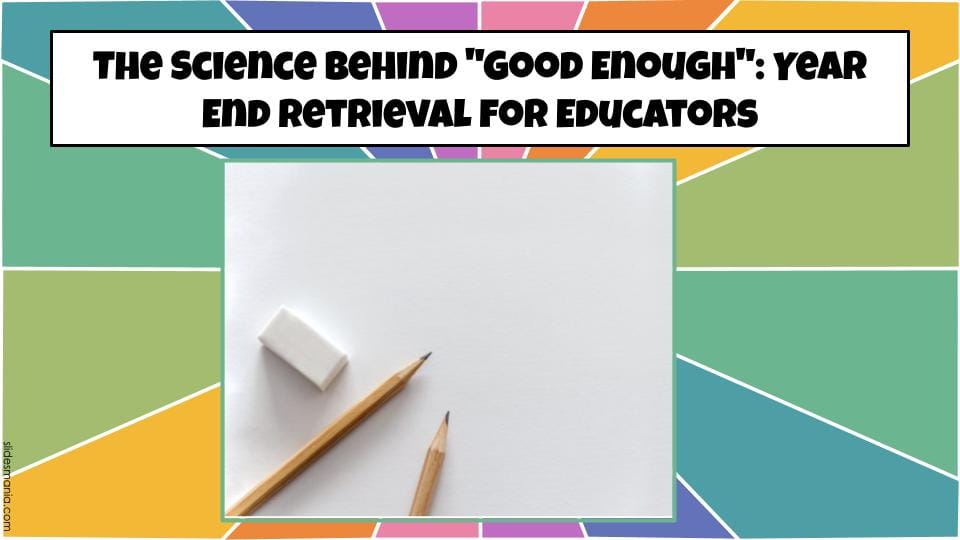
Take out a blank piece of paper and answer:
- What are two moments this year when students learned something meaningful?
- What are two challenges that taught you something as an educator?
- What are two practices you want to bring into next year?
This reflection aligns with an important principle of Universal Design for Learning: expert learners develop through self-reflection, self-regulation, and an understanding that variability is normal.
Pause and let the answers come slowly. The effort is the point; retrieval practice shows that learning strengthens when we work to bring information back to mind. In cognitive science, this is called “desirable difficulty.”
After your brain dump, you may discover something surprising: successes that never made it into the story you were telling yourself. Only then should you revisit your notes, photos, emails, or lesson plans to see what else emerges.
So if you are ending this school year imperfectly with unfinished tasks, a messy desk, forty-seven tabs open in your brain, and the feeling that you could have done more…you are in very good company.
I am writing this as much for myself as anyone else: your imperfections are what make you more than enough for your students. After all, students are not the only variable learners in the room.
References
Neff, K. D. (2011). Self-compassion, self-esteem, and well-being. Social and Personality Psychology Compass, 5(1), 1–12. https://doi.org/10.1111/j.1751-9004.2010.00330.x
Neff, K. D., & Germer, C. K. (2013). A pilot study and randomized controlled trial of the mindful self-compassion program. Journal of Clinical Psychology, 69(1), 28–44. https://doi.org/10.1002/jclp.21923
Simon, H. A. (1957). Models of man: Social and rational. Wiley.
Simon, H. A. (1955). A behavioral model of rational choice. Quarterly Journal of Economics, 69(1), 99–118.
Winnicott, D. W. (1953). Transitional objects and transitional phenomena. International Journal of Psychoanalysis, 34, 89–97.
Sidebotham, C. (2017). Good enough is good enough! British Journal of General Practice, 67(660), 311. https://doi.org/10.3399/bjgp17X691409