Open Hearts and Minds for End-Of-Year Connections
At the end of the school year, reflection can become retrieval helping teachers and students notice growth, remember connection, and carry learning forward.
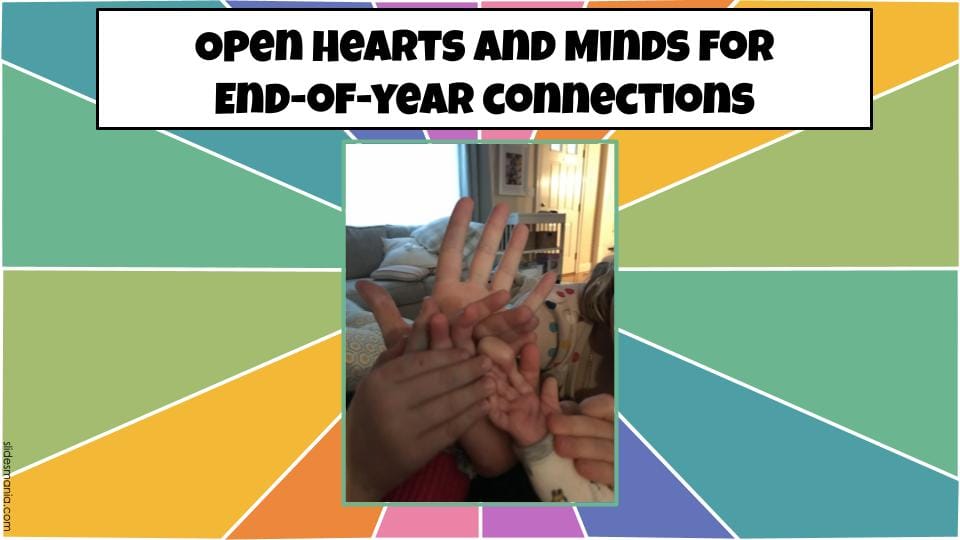
Teaching in May feels like trying to finish strong while also just trying to get through. The cognitive load is real: grading unfinished, curriculum moving, students needing support, and the constant awareness that the year is ending and weather is getting nicer (cue the, "can we have class outside?"). And somewhere in the middle of that exhaustion, the inner critic gets loud with all the “shoulds.”
I should have used that book corner more...I should have done the other activity...I should have slowed down or done something different to reach that student...I should have caught that sooner...
The “shoulds” rarely lead to clarity. More often, they just create noise, and we all know there is more than enough noise in classrooms, homes, and our own minds this time of year.
As we inch toward the end of the school year, I’ve shifted the “shoulds” from judgment and self-correction toward better questions with end-of-year reflections: What actually happened this year? What moments stayed with me? What learning took root, even if it didn’t look perfect in the moment?
End-of-year reflections help bring learning back into focus and surface what the “shoulds” often bury: connection, growth, and the moments that don’t always show up in data, but shape everything else.
That kind of retrieval is not about romanticizing the year or pretending everything worked. It is about noticing honestly, with an open heart and mind, what deserves to be remembered, revised, released, and carried forward.
“Shoulds” and Sustainability
The shift from the “shoulds” to meaning-making comes from teaching a few semesters at Fitchburg State University, where I designed and taught an online graduate course for educators called The Good Life for Educators: The Science of Sustainability and Joy in Teaching. The course was partly inspired by Dr. Laurie Santos and her wildly popular Yale course, Psychology and the Good Life, which became one of the most-enrolled classes in Yale's history. It was also inspired by the simple truth that I needed it myself.
Designing, teaching, and learning alongside a diverse group of educators, including psychologists, counselors, nurses, and administrators, over the past few semesters gave me new insight into how we can lighten our internal load and shift the narrative toward something more sustaining: connection, curiosity, laughter, and the small human moments that often get buried beneath cognitive overload.
What made my Good Life for Educators course different from most professional development is what Dr. Laurie Santos calls “rewirements,” or small, weekly practices designed to shift the habits and mindset patterns that quietly shape how we move through our work. Drawn from positive psychology research, these practices are low-stakes and ungraded, which for many educators is itself a meaningful shift.
But the deeper insight is this: building resilience and well-being requires more than understanding ideas. It requires intentional, repeated practice that interrupts automatic patterns and replaces them with more sustaining ones.
And that idea feels especially important in May, when the cognitive load of teaching is at its highest and everything feels like it is happening at once.
Retrieval, Reflection, and the Science of Connection
When I look at what actually sustains teachers and students over time, the research aligns with what many of us already feel in our best and hardest moments: connection.
Teachers’ emotional health directly affects their interactions with students and the classroom environments they create. Research shows that educators with higher well-being engage more positively with students, shaping conditions that support both academic and social growth (U.S. Department of Education).
That made me wonder: if educator well-being shapes everything from classroom climate to student learning, why don’t we spend more time studying what actually sustains human happiness, connection, and resilience over time?
One of the central ideas of the Good Life for Educators course came from the Harvard Study of Adult Development, often called the 80-year happiness study. It is one of the longest-running studies on human well-being, beginning in 1938 and following participants over more than eight decades of life: careers, relationships, illness, success, aging, and loss. Researchers gathered interviews, medical records, surveys, brain scans, and family data over the course of nearly a century.
After all of that, the conclusion was remarkably simple.
The quality of our relationships is one of the strongest predictors of happiness, health, and longevity.
Not wealth, achievement, or productivity, but connection.
People with strong, supportive relationships tended to live longer, experience less stress-related illness, report greater life satisfaction, and recover more effectively from hardship. As psychiatrist Robert Waldinger, the current director of the study, put it:
Good relationships keep us happier and healthier. Period.
What makes this research especially relevant for educators is not just the conclusion, but the “why” behind it. The study did not find that people need large social networks or constant positivity. What mattered most was the simple, consistent sense that someone is there for you. It is the individual's experience of safety, trust, and belonging; the feeling of being connected to others rather than carrying life alone.
When I think back on the moments that sustained me this school year particularly as a high school teacher, they were rarely tied to curriculum maps or assessment data. They were relational moments.
A student lingering after class to ask for a recommendation letter, and staying to talk long after it was about the letter. A student inspired by our pet hamster, Pumpkin, showed me their "promposal" picture with their new hamster. A student trusting me enough to tell me something they hadn't shared with anyone yet, and lovingly bringing me to tears.
And colleagues who stayed with me well past the bell to work through hard dilemmas. Talking through difficult decisions, sharing stories from life outside school, sharing chocolate in the teachers lounge, laughing about daily blunders, or reminding me at just the right moment that saying no is also part of sustainability - thank you, dear colleagues!
Relationships are not a distraction from the work. They are what make the work possible and worth doing, and they are one of the mechanisms through which learning becomes meaningful and through which we sustain ourselves in this profession. This becomes especially clear in end-of-year retrieval and reflection with students.
Designing End-of-Year Retrieval and Reflection
End-of-year reflection is a structured opportunity for retrieval and connection. It helps students recognize their growth, revisit what mattered, and make meaning from the year they just lived.
During one of my weekly “Friday Feedbacks,” a student shared that when he traveled abroad with the school trip, he felt proud that he could ask for directions in the target language, but when it came time to actually understand and follow the directions he received, he was completely lost.
As we approached one of our final experiences together this year, I kept coming back to his story. I wanted to build something around it; something rooted in language, memory, and navigation.
I created sentence starters for giving directions and designed an activity where students’ final essays, peer feedback, and their first free write from the beginning of the year are hidden throughout the library in photocopy paper boxes labeled with directional clues. Only a few students know the locations. Their job is to guide others there, passing directions from peer to peer until the entire class finds their work.
Once students arrive and open their boxes, they revisit both their first and most recent writing and peer feedback. Inside, there is also a note inviting them to complete their own glow-and-grow reflection. I’m also embedding a short survey about what worked this year, what didn’t, and what they wish had been different so I can better understand my own teaching.
I’ve also built in a layer of UDL choice, allowing students to respond through writing, drawing, SmashDoodles, or other visual reflections. Sometimes students communicate their thinking more honestly when they have multiple ways to express it.
In the end, the activity is simply a way for students to return to their own learning, see growth, revisit experience, and notice the relationships that shaped the year.
Year-in-Review: Collective Retrieval of the Year
Another practice I return to is creating a short year-in-review video for my senior classes. I took screenshots from each unit - slides, activities, projects, moments from class, and dropped them into iMovie alongside songs we listened to throughout the year.
Truth be told, it took me longer than it should have since I ended up personalizing it a bit with some of the students' work and pictures. But I also found myself enjoying the process. Making the video helped me retrieve what we had done together and close out the year too.
In the end, the final video turned out to be more than a review of the curriculum, but rather a review of a shared experience. A reminder of how much we actually lived together in that room.
And maybe that is what this kind of year-in-review work is really about: showing students that language is more than what we can say. It is what we can understand, navigate, and do together with other people.
Practical Ways to Carry Something Forward
If possible, build space into the agenda for students to meander a bit at the end of the year. Give them opportunities to share what helped them learn, what moments stayed with them, and what they would suggest trying for future classes.
There are many ways to do this:
- letters to next year’s students
- anonymous reflections
- voice notes
- collaborative advice walls especially if the students need movement
- walk-and-talk reflections
- sketch notes or visual responses
The format matters less than the invitation itself.
That said, reflection can feel vulnerable. There have been many a year or class where reading student feedback has made me feel fragile and sad. Questions shape emotional tone, so framing reflection questions in ways that lift everyone up rather than tear anyone down is important. Reflection should create opportunities for honesty and growth, not become another space for shame or self-criticism.
Offering multiple ways to respond can also help students feel more comfortable participating. Students might:
- write
- leave sticky notes
- record a voice memo
- draw or sketch-note
- collaborate with peers
- choose only the prompts that resonate with them
To help students enter reflection with more clarity, I like to organize prompts by purpose.
- Retrieve Learning
- What is something you can do now that felt difficult at the beginning of the year?
- Which activity, project, song, or conversation helped learning “stick”?
- Describe a moment when you realized you understood more than you expected.
- Reflect on Growth
- How did you grow academically, personally, or socially this year?
- What challenge did you work through?
- What is something you are proud of that may not show up in a grade?
- Connection and Classroom Community
- When did you feel most connected in class?
- What helped you feel safe or comfortable participating?
- What is one moment from this class you think you will remember?
- Looking Ahead
- What advice would you give next year’s students?
- What should future classes definitely keep doing?
- What is something from this class you want to carry into the future?
Sentence starters can also help students begin reflecting:
- “I felt most connected to learning when…”
- “One thing I will carry with me is…”
- “A moment that surprised me was…”
- “I’ll remember…”
- “I was proud when…”
With questions such as these, the end of the year can become less about closing things down and more about noticing what deserves to come with us into the next beginning.
And hey, sometimes what students remember most is not the perfect lesson, but the way a classroom felt to them and the people in it.
What Sustained This Year
I have been sitting with a quote by Dr. Vivek Murthy:
"If you want to build relationships, you have to be willing to waste time with other people."
He goes on to explain that if we want to build community, we need unhurried time where conversations are allowed to meander. Time simply spent in the presence of another human being, with an open heart and an open mind.
As teachers agendas are mandatory and at this point in the year, we do not feel like we have time to “waste” in class, or in our own lives, for that matter. With every moment accounted for between school, my three kids, and everything else pulling at me, goodness, I notice if I keep going with my to-do list, my own cognitive overload will get the best of me.
But what if we make space on the agenda for opening our hearts and minds? Can we help students recognize who they have become, what they have learned, and what we have built together along the way?
That is not wasted time. That is where the connection grows, and a few small shifts can help us make more space for it.
Choose One Small Way to Reconnect
- Choose one moment a day to stop optimizing. Let the copies finish printing without answering another email. Sit in your car before walking inside instead of immediately scrolling your phone. Notice what happens in the few minutes you reclaim.
- Create unhurried time with someone you care about, whether it is a colleague, a student, or someone at home. Shared presence without an agenda matters more than we often realize.
- Audit your time honestly. Where does your attention quietly drain? Which low-stakes tasks crowd out the things that matter most? Just notice.
- And finally, protect one recurring window for connection. A walk with a colleague, a standing coffee or tea before school, or a phone call you do not rush. It does not have to be long, but it does have to be real.
- At the end of the year, perhaps the most meaningful thing we can carry forward is the reminder that relationships were never separate from the learning. They were part of the learning all along.
Wishing you all some unhurried time to meander, be present, and connect.
This post is inspired by The Good Life for Educators: The Science of Sustainability and Joy in Teaching, a graduate course I'm teaching for educators at Fitchburg State University.
References
Gallup. (2023). State of the global workplace: Employee engagement insights for business leaders worldwide. Gallup Press.
Murthy, V. H. (2023). Our epidemic of loneliness and isolation: The U.S. Surgeon General's advisory on the healing effects of social connection and community. U.S. Department of Health and Human Services.
Murthy, V. H. (2026, March). If you want to build community, you have to “waste time” with people. Substack. https://vivekmurthy.substack.com/p/if-you-want-to-build-community-you
U.S. Department of Education. (2023). Teacher well-being: A resource guide. https://www.ed.gov/media/document/eirteacher-wellbeing508-107807.pdf
Waldinger, R., & Schulz, M. (2023). The good life: Lessons from the world's longest scientific study of happiness. Simon & Schuster.