They Look Engaged, But Are They Learning?
What if some of the things we have been calling "engagement" are actually measures of compliance, activity, or enjoyment rather than learning?
After presenting at the 2026 MaFLA conference (with a few takeaways at the end), I've been taking a deep dive into cognitive science through Dr. Carl Hendrick's work to explore engagement, cognitive load, retrieval, feedback, transfer, and durable learning... and goodness, it has turned my view of the importance of ENGAGEMENT upside down.
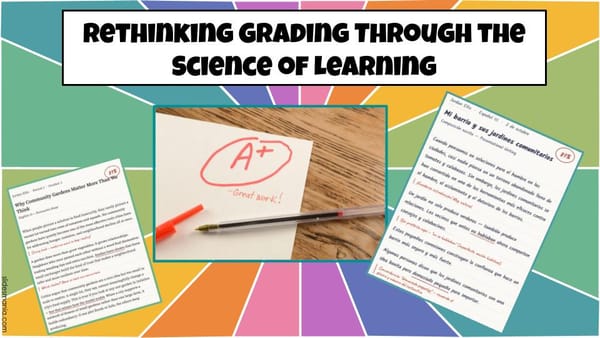
This fall I've been rethinking things I used to take for granted in my classroom: first grading, then feedback, and now... engagement. So what do we mean when we say students are engaged? And how do we know learning is actually happening?
Researchers and authors in the science of learning Paul Kirschner, Carl Hendrick, and Jim Heal caution us not to confuse visible engagement with actual learning. Students can be busy, participating, and even enjoying an activity without having to think very hard or learn anything new. Their 2025 book Instructional Illusions describes an "engagement illusion": the assumption that a busy or visibly engaged student must be learning.
We've been told to make learning engaging, so we add:
- movement
- choice
- collaboration
- discussion
- games
- technology
- colorful materials
- activities
- novelty
And sometimes we look around and think, yay, they're engaged!
But How Do We Know Learning Is Actually Happening?
How many times have we sat staring at a speaker, looking like we're paying attention while planning out grocery shopping or dinner?
Similarly, a student can look engaged in many ways:
- Staring intently at a slideshow.
- Enthusiastically completing a colorful activity.
- Talking animatedly with a partner.
However, visible engagement is not the same as cognitive engagement.
And what happens when we ask them two days later, "What do you remember?" Or, "Can you use it without the supports you had yesterday?"
Drawing on Robert Bjork's distinction between short-term performance and long-term learning, Hendrick and his coauthors remind us that a classroom can be full of visible activity and still produce very little durable learning. A student might be talking without thinking deeply, working without learning, succeeding because the task or teacher gives away the answer, staying busy with something they already know, or enjoying an activity that places very little demand on the knowledge we actually want them to learn.
The authors argue that engagement is a poor proxy for learning. His argument connects to the work of Rob Coe, an education researcher known for examining the limitations of common indicators of learning, and Graham Nuthall, an educational researcher who studied what happens inside classrooms. Nuthall found that students can be busy and involved in activities while working with material they already know. In other words, the visible activity we often interpret as engagement can tell us surprisingly little about whether learning is taking place.
A student can look engaged without learning much, and a student can be learning without looking particularly engaged.
So What Do We Mean By Engagement?
Researchers Jennifer Fredricks, Phyllis Blumenfeld, and Alison Paris describe engagement as multidimensional, distinguishing between behavioral, emotional, and cognitive engagement. Engagement involves more than what we see students doing. It also includes how they feel and how they think about their learning.
But here's the tricky part: even when students appear engaged, we can't assume that learning is taking place.
The question isn't "Are my students engaged?" It's "Engaged in what?"
One student can be completely absorbed in making a slideshow look beautiful, chatting with a friend, or completing a task they could have done in their sleep. They can be busy, enthusiastic, and having a great time without doing much thinking about what we're trying to teach.
Another student can be struggling to explain an idea, searching their memory for the right word, or wrestling with something they don't quite understand yet.
Both students might look engaged, but what are they actually learning?
Behavioral and emotional engagement can support learning, but neither alone tells us whether students are developing knowledge they can retrieve and use later.
So what evidence would convince us that learning has actually happened, and will students still be able to use that knowledge tomorrow, next week, or independently?
Lessen the Cognitive Load: Make the Ordinary Extraordinary
Performance during a lesson isn't the same as learning that lasts.
Hendrick and Macpherson have described the goal as a more "streamlined classroom," reducing cognitive load and pruning activities that create noise without contributing to learning.
This shift reduces the cognitive load for educators, too, since we don't need to manufacture a new, elaborate activity every time. We can start by asking: What do students need to think about right now? Then remove what competes with that thinking.
One way I do this is by making the incredibly ordinary extraordinarily detailed.
Every week, I start with a charla, or what I call "retrieval" or recuperación, about my weekend. This is when I usually try to create a ridiculous story about something relatively ordinary that I did over the weekend and reuse key vocabulary from the previous week.
Lately my stories have included the challenges of putting IKEA furniture together, teaching the turtle to skateboard, watching the neighborhood kids put hockey padding on my son en plan Mighty Ducks and then shoot pucks at him, organizing the junk drawer, the mouse that might have slipped into the house because the kids keep leaving the door open (and what the students think I should do about it), and the time we lost our hamster. Here's an example:
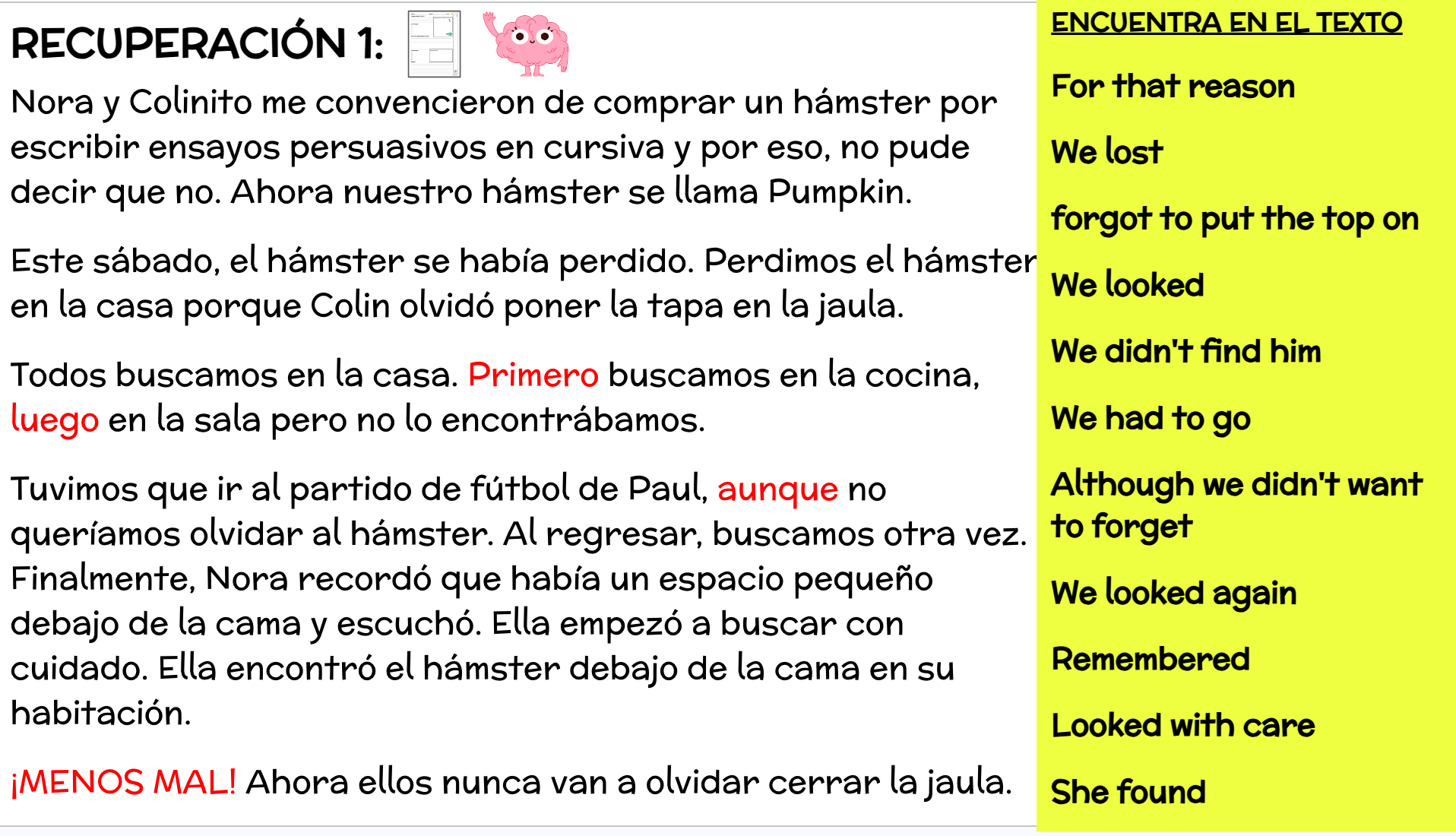
My ordinary story goal is simple: work the key verbs from the previous week into my story with details so students have to retrieve them. I always model first, often making myself vulnerable and sometimes silly, before moving into personalized questions:
Do you have a pet? Have you ever lost one? Do you lose things in your house? Do you lose your phone sometimes? Is your room clean or dirty? Have you ever lost something under your bed? What would we find if we looked under your bed?
Even when I don't have a particularly ridiculous story, ordinary life is enough. What I brought home from Costco, for example, can become a story. All it takes is adding a few tiny details to make an ordinary experience more interesting and give students something to picture, relate to, wonder about, and talk about.
This weekend, it was my long commute home from MaFLA, my gas and oil light coming on, or how I raced from the conference to meet my friend in Coolidge Corner for one of the only showings of La bola negra. As we waited for the lights to dim in the old-fashioned, charming theater, we heard Spanish conversations all around us and noticed how many people had dressed up for the occasion. The whole experience made the frantic parking search, my flustered arrival, delicious crepes, and our short time together feel more than worth it (if you are reading this, thanks, Sarah!).
I'm not telling these stories simply because they're entertaining. I'm using ordinary, memorable content to give students opportunities to retrieve high-frequency vocabulary in a real-life context, with something worth talking about in Spanish...ideally, something students can connect to their own lives!
The story itself isn't the learning; what matters is what students are thinking about, retrieving, and connecting to as they listen and respond. My students may react silently or participate... but the more interesting evidence comes later:
- Can they retrieve the language?
- Can they recognize it in a new context?
- Can they pull out the target phrases we learned last week?
- Can they understand it when the original supports disappear?
- Can they retrieve it next week?
Engagement might get students through the door. But learning is what happens when something changes in what they know and can do.
The story creates a context for learning, but we also need to make room for the thinking that makes learning possible.
Protect Limited Working Memory
If we want students to learn, we need to protect their limited working memory and help them connect to prior learning so they have the mental space for the thinking that matters.
So instead of asking educators to make lessons more stimulating, elaborate, novel, or entertaining, we can ask: What is competing with the learning?
- Maybe the directions are too complicated.
- Maybe the slide has too much information.
- Maybe students are trying to listen, read, copy, navigate technology, remember instructions, and formulate an answer simultaneously.
- Maybe the activity is novel, but the novelty has nothing to do with the learning goal.
- Maybe we're asking students to solve the task instead of think about the content.
Let's slow ourselves down and do a cognitive load audit.
Cognitive Load Audit
Before the lesson:
What do I want students to think about?
During the lesson:
What is making that thinking harder than it needs to be?
Three Pieces of Evidence
After the lesson:
1. Can they retrieve it later? Does it stick?
Can they remember it tomorrow? Next week? After the supports are gone?
Ebbinghaus's forgetting curve is a good reminder here. In his experiments with lists of nonsense syllables, he found that forgetting happens quickly, with substantial information lost within the first hour and over the following days. (I wrote more about this in Cognitive Overload Is Why Students Disengage Before the Lesson Even Starts.) If we never ask students to retrieve what they've learned, much of what appeared to be learned during class may not be there next week.
2. Can they use it without the original scaffolds?
A student who can complete an activity with the teacher, a word bank, a model, a partner, sentence frames, and examples has demonstrated something. But what happens when those supports disappear? Can they do something with the knowledge independently?
3. Can they transfer it?
Can students use what they learned in a new situation? If students acquired language through my story about the escaped hamster, can they later use the same language to tell a completely different story? I've found it really helps to explicitly remind them of the hamster story when I give them a cue to tell their own! Sometimes, making those connections explicit for students is one of the kindest ways we can support long-lasting transfer.
Learning is not just what students can do today. It is what they can still do later.
Takeaway on Engagement
I still want my students to be engaged and listen to my ridiculous stories. I want them to talk to each other, care about what we're doing, and have fun, but I am becoming much more careful about what I count as evidence of learning.
A quiet student might be thinking; a noisy student might be performing, and a student who looks uncomfortable might be doing the hardest thinking of the day.
We don't need to keep adding things to classrooms. Sometimes better teaching means taking things away and making the ordinary extraordinary by explicitly teaching the details of everyday experiences and connecting them to our students' own lives. It's about removing unnecessary work so students have more mental space for the work that matters to them.
What's something ordinary in your lesson today that you could make extraordinary by adding a few tiny details and allowing students to connect it to their own lives?
Finally, a few highlights from MaFLA. I went to Kara Jacobs's presentation, "Spoiler Alert," and she is so incredibly generous with the resources on her blog here. I was also inspired to go to Dr. L.J. Randolph Jr.'s presentation on Enacting Anticolonial and Antiracist Pedagogies with the incredible Timothy Chávez, whose blog is Communicative Teacher (if you are reading, thank you, Timothy!). They both focus on language acquisition research, along with social justice and cultural standards. I left with so many ideas to think about and take in, and I'm glad I made time for both.
References
- Coe, R. (2013). Improving education: A triumph of hope over experience. Centre for Evaluation and Monitoring, Durham University.
- Ebbinghaus, H. (1885/1913). Memory: A contribution to experimental psychology (H. A. Ruger & C. E. Bussenius, Trans.). Teachers College, Columbia University.
- Fredricks, J. A., Blumenfeld, P. C., & Paris, A. H. (2004). School engagement: Potential of the concept, state of the evidence. Review of Educational Research, 74(1), 59–109.
- Hendrick, C., & Macpherson, R. (2017). What does this look like in the classroom? Bridging the gap between research and practice. John Catt.
- Kirschner, P. A., Hendrick, C., & Heal, J. (2022). How teaching happens: Seminal works in teaching and teacher effectiveness and what they mean in practice. Routledge.
- Kirschner, P. A., Hendrick, C., & Heal, J. (2025). Instructional illusions. Hachette Learning.
- Murre, J. M. J., & Dros, J. (2015). Replication and analysis of Ebbinghaus' forgetting curve. PLoS ONE, 10(7), e0120644.
- Nuthall, G. (2007). The hidden lives of learners. NZCER Press.
- Soderstrom, N. C., & Bjork, R. A. (2015). Learning versus performance: An integrative review. Perspectives on Psychological Science, 10(2), 176–199.