When Helping Gets in the Way: Rethinking Feedback
Feedback doesn't improve learning just because we give it. What makes it usable: one clear message, a focus on the work, better timing, and a real chance for students to retrieve and revise.
Praise, Feedback, and Motivation: What Are We Communicating to Students?
In Rethinking Grading Through the Science of Learning, I wrote about a scene from the film Radical: a sixth-grade teacher gives every student a 10 on the first day so they can stop worrying about the grade and get everyone back to learning. Then he asks the show-stopper question:
“So, who wants to be wrong first?”
That post explored what happens when grades compete with feedback for students' attention. I've been thinking about another side of that conversation. What about the feedback we give students every day?
When should we give it? How much should we give? Should we correct the mistake or ask a question? Should we step in or wait? Is written feedback better than oral feedback? And what happens when students receive our carefully crafted comments but never actually do anything with them?
Which brings me to a question I keep coming back to:
Can we be "too" helpful as educators, parents, and humans?
When a child says, “I don't get it,” our first instinct is usually to jump in.
Here, let me show you.
I know mine is...except sometimes that may be the very thing I should not do.
The more I explore feedback, retrieval, memory, and how people learn, I wonder whether some of the feedback I try to give so generously is not so helpful.
But before we get to feedback, let's talk about praise.
Genuine Praise: Sometimes We Just Need to Feel Seen
Quite a few years ago, when my own kids were under 5, I left a school where I had taught middle and high school for nine years to teach K–5 elementary Spanish.
I went from teaching five courses with about 100 students total to bouncing between 10–12 elementary classrooms, grades K–5, for 30-minute lessons. Suddenly, I was seeing almost 300 kids a week!
I was humbled back into being a brand-new teacher.
There were students' names to memorize, a completely different school culture to learn, and the challenge of maximizing those precious 30 minutes. The context switches from first grade to fifth grade, then back to fourth, second, and third made my head spin.
I eventually realized that learners of ALL ages benefit from movement, song, retrieval, Write and Discuss, with a little novelty woven into familiar routines. But at the beginning of that first year, I was just trying to keep my head above water.
Desperate for ideas and inspiration, I signed up for TCI Maine conference, where La Maestra Loca was presenting.
During the first session, one of my coworkers let it slip that it was my birthday. La Maestra Loca immediately figured out how to make a colorful, magical unicorn float across her screen to celebrate. Now, I'm not someone who makes a big deal out of my birthday, but her enthusiasm was absolutely contagious.
She made me feel so seen and suddenly, we were ALL celebrating in the target language as if it were everyone's birthday. I felt such joy and smiled throughout her entire session, soaking up her ideas about storytelling and reaching all those little learners in the tiny amount of time I had with them.
I ended up skipping another session I'd planned to attend so that I could learn more from her. What struck me wasn't simply her teaching strategies. It was how she made me feel as a learner.
I see you. You matter here.
Sheesh, I didn't realize how much I needed to hear that, especially in the middle of what felt like a HUGE teaching crisis over how hard it was to adjust to teaching 6- through 11-year-olds. I can still retrieve that memory years later because of how she made me feel. Emotion can help make memories stick, and goodness, do I remember that unicorn!
If you haven't heard La Maestra Loca’s recent podcast on The Power of Praise, it's worth checking out.
Her gesture reminded me how powerful genuine praise and encouragement can be. They can help establish belonging, build relationships, and make people feel more willing to take risks. It can pave the way for safety, confidence, risk-taking, and a positive classroom culture, which matters enormously in a classroom and was exactly what I needed to regain my footing and confidence to teach my new littles. At the time, I didn´t need information about how to improve my teaching; I needed that praise and encouragement to remind me that I could do it (thank you, La Maestra Loca!).
Praise and Feedback: Different Purposes, Shared Potential
For a long time, I thought of praise as another form of feedback. Now, I'm starting to think more carefully about what each communicates. Praise can convey appreciation, encouragement, celebration, and a sense of belonging. Feedback, on the other hand, gives learners information about their performance that they can use to understand where they are and what to do next.
Below is how I broke down the different purposes of praise and feedback:
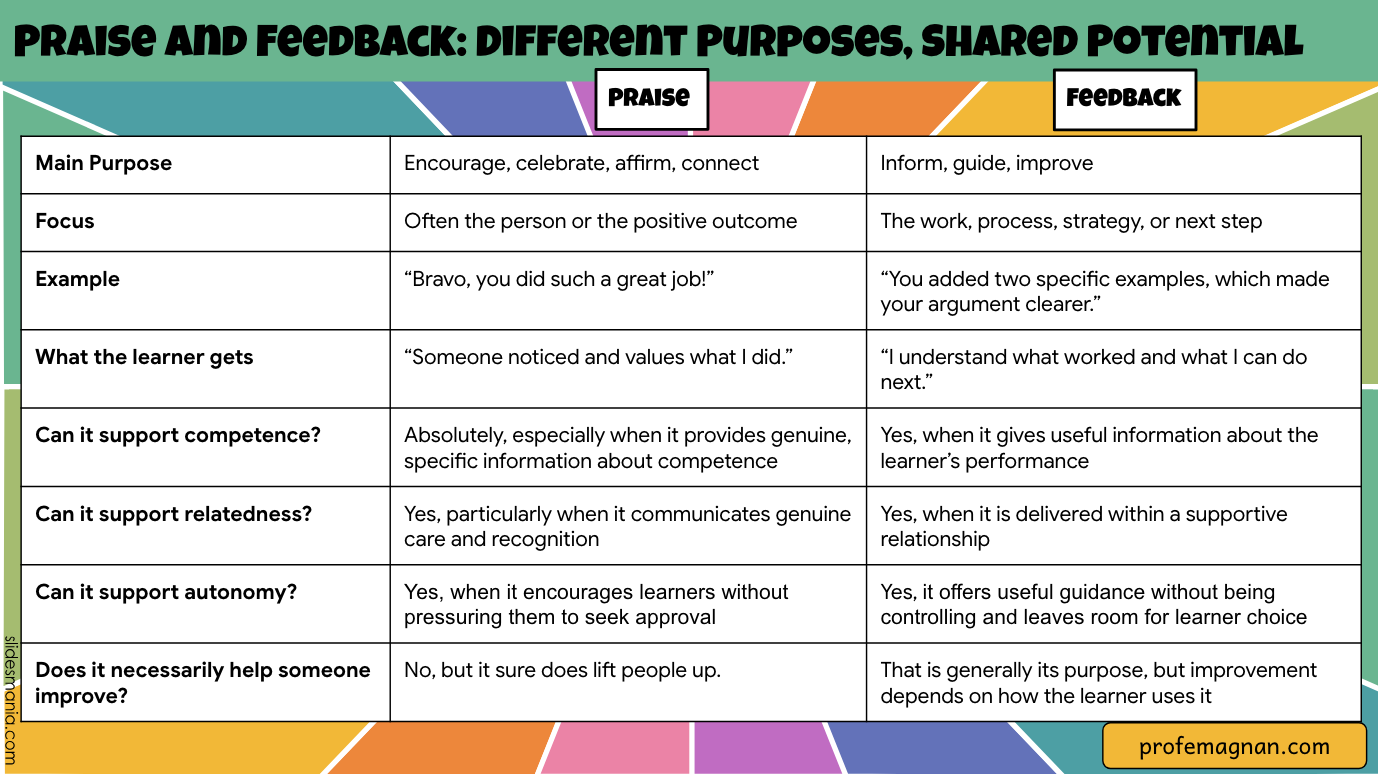
Dr. Liam Printer’s work on motivation in the language classroom inspired me to think about the distinction. Self-Determination Theory identifies three important psychological needs: competence, autonomy, and relatedness. Specific, meaningful feedback can support a learner’s sense of competence, while supportive relationships foster autonomy and relatedness.
That birthday unicorn wasn't instructional feedback, but it certainly made me want to keep learning.
What Are Our Words Actually Communicating?
Knowing the difference between praise and feedback is one thing, however, recognizing what our words actually communicate is another.
Think about how often we say:
“You're so smart!” “Great job!" or “You're so good at [fill in blank]!”?
Good golly, I've said versions of all of these plenty of times myself. These comments communicate warmth, and goodness knows warmth matters. However, these words tell the learner surprisingly little about the work and what they can carry forward.
Compare that with comments that direct students toward specific improvements such as:
- “Your description included a variety of transition words.”
- “Try adding another reason to support your opinion.”
- “You used the past tense accurately here. Can you find another place where the same pattern would work?”
These comments give students something specific to notice, understand, and potentially do again.
Carol Dweck's research on praise and mindset has helped educators think more carefully about the messages we send when praising intelligence or ability versus strategies, effort, and persistence. Dweck has also cautioned against turning growth mindset into simply praising effort, regardless of whether that effort is productive.
That applies at home, too.
When my kids ask me to “Watch this!” and then perform some new gymnastics move, make a new Lego creation, or show me something they have been practicing, my first instinct is often:
“Wow! Good job!” (repeat approximately 47 times)
And sometimes that is absolutely enough. I am their mom, not their instructional coach.
But if I have the energy that day, I can get more specific:
“You kept trying different ways to make that work.”
“You changed your approach when the first one didn't work.”
“You remembered the strategy you practiced yesterday.”
These comments point out something the child did that they might recognize and try again.
Don't worry, you can do this without turning every family interaction into a mini lesson. When a child shows you a drawing, you might notice a specific choice rather than simply saying “You're a great artist.”
“I noticed how you used darker lines here to make that part stand out.”
And sometimes, instead of praise or correction, what a child really needs is a question. For example, when a child is struggling with homework, instead of jumping in with “You're so smart. You can do this,” we might ask:
“What have you tried so far?”
“Which part do you understand?”
“What could you try next?”
And when a child finally solves a difficult problem, we can celebrate the result while also noticing what helped them get there:
“You stuck with it and tried a different strategy when the first one didn't work.”
When we rely on “Good job!” for everything, it can become background noise. A specific, genuine comment can help a learner recognize something worth carrying forward. For example:
“You went back and added another reason to support your opinion. That made your argument much clearer.”
When Feedback Becomes Too Much
Even when we know what we want to communicate, we can muddy the message by trying to say too much at once.
I came across a headline in Carl Hendrick’s Learning Dispatch:
Negative feedback is fine. Mixed messages are not.
How often have we tried to soften a correction by wrapping it in praise?
“Great job, but you need to fix all these things...”
We don't want to tell a student that everything is wonderful when it isn't. At the same time, we don't want a student to walk away thinking, I'm just bad at this.
So...we combine the two types of feedback; however, they don't need to be communicated as competing messages at the same time.
Powell, Rentzelas, and Kambouri´s study on different kinds of mixed messages recently came out in Learning and Instruction. The researchers found that mixed comparative feedback was associated with lower subsequent task performance, while consistently negative comparative feedback was associated with better performance. Consistently positive comparative feedback showed no performance effect in that study.
Importantly, the participants were undergraduate students, not elementary or secondary language learners. And the findings concern particular types of comparative feedback, not every combination of praise and correction.
My takeaway is to decide what the student most needs to hear and communicate that message clearly and kindly. If a student needs to improve, explain what needs work and give specific guidance. If the message is that they've made progress, point to the evidence.
Instead of listing everything I notice, I'm trying to ask myself:
What is the most useful thing this student needs to know right now?
Especially in language learning, one encounter is rarely enough. Sometimes the best feedback isn't another explanation. It's another chance to remember, revise, and try again.
As Brené Brown reminds us, clear is kind. We can be honest about what needs to change without making the learner feel that they are the problem.
When to Intervene, and When Not To
This is where feedback gets particularly difficult for me as a teacher (and a parent).
I have realized that one of my own greatest challenges is knowing when not to intervene.
I genuinely enjoy talking with people (students, children, and adults). When they struggle, every instinct tells me to jump in, explain the answer, and help them move forward. Yet intervening too quickly may actually reduce learning.
Instead of immediately supplying answers, Wiliam (2018) recommends responding with prompts such as:
"Tell me what you do understand."
"What does this remind you of?"
"Start with what you know, and I'll come back in a few minutes."
This connects to what cognitive scientists Robert and Elizabeth Bjork call desirable difficulties: learning conditions that can make performance feel harder during practice but support longer-term retention and transfer. Retrieval practice and spacing are examples. They are useful when the difficulty requires learners to engage in productive cognitive work.
And this is where I have started thinking about learned helplessness, too.
I don't want to overstate this. A teacher helping a struggling student does not create learned helplessness. There is a meaningful difference between supporting a learner's agency and replacing it.
If we consistently step in, supply the answer, or remove every opportunity to figure something out, are we giving students enough chances to experience themselves as capable of influencing the outcome?
So I am learning to tolerate a little more silence, a little more wait time, and a little more:
“What do you already know?”
And a little less:
“Here, let me show you.”
What Happens After the Feedback?
One of the most interesting insights I've taken from Dr. Carl Hendrick is that feedback doesn't improve learning simply because we give it. It needs to change what students know and can do.
I can spend time writing thoughtful comments, highlighting errors, or carefully explaining what needs improvement. But if students read those comments, put the paper away, and move on, what actually changed?
More feedback is not automatically better feedback.
Give feedback too early, and students may learn less because we have done some of the thinking for them. Give them too much, and we can overwhelm their attention rather than support their learning.
What matters is not simply how much feedback we give, but what we give students to work with, and what they do with it.
The same idea applies to oral and written feedback. One format is not automatically better than the other. Wiliam (2018) discusses a study in which students who received oral feedback performed better than students in the other groups. But those students also had time in class to use the feedback to improve their work, so the study couldn't establish that oral feedback itself made the difference.
The format of feedback matters less than what students are able to do with it.
We can intend our feedback to be helpful and still have no idea exactly how a person will receive it. Wiliam (2018) draws on research showing that people can interpret success and failure in very different ways. They may attribute a success or failure to something internal or external, something stable or temporary, and they may even overgeneralize from one experience to another. A student can hear “You did well on this” as evidence of an ability they possess, while another student may hear it as evidence that the particular strategy they used worked.
So the question is not simply:
Did I give feedback?
It is:
What did the student do after receiving it?
We cannot completely control how a student responds to feedback. But we can design the conditions around it. We do not need to tell students everything we notice, but rather identify the one thing most likely to move the learning forward, give students enough information to act on it, and then get out of the way.
What I Am Trying to Do Differently
For me, the shift toward more effective feedback has been surprisingly small but meaningful: less telling, more noticing; less correcting, more retrieving; and more opportunities to do something with feedback.
Instead of always telling students the correct answer, I want to create more opportunities for them to retrieve what they already know. That might mean offering a hint without doing all the thinking for them, asking a question that sparks curiosity or helps them recognize what they know and what they still need to figure out, or, perhaps most importantly, simply giving them time to think and time in class to revise before stepping in.
I am far from having this all figured out, but perhaps the hardest part is knowing when to step back. This does not mean withholding needed information or turning every mistake into a guessing game. Sometimes a clear explanation is an act of kindness. And other times, whether we're children or adults, we just need someone to say, “You've got this.”
Wishing you energy to praise your heart out and give feedback filled with intention, and the wisdom to know when to say less.
References
Bjork, R. A., & Bjork, E. L. (2020). Desirable difficulties in theory and practice. Journal of Applied Research in Memory and Cognition, 9(4), 475–479. https://doi.org/10.1016/j.jarmac.2020.09.003
Dweck, C. S. (2006). Mindset: The new psychology of success. Random House.
Dweck, C. S. (2015, September 22). Carol Dweck revisits the “growth mindset.” Education Week.
Hendrick, C. (2026, June 8). The monthly dispatch. The Learning Dispatch. https://carlhendrick.substack.com/p/the-monthly-dispatch-whats-new-in-a9a
Maier, S. F., & Seligman, M. E. P. (2016). Learned helplessness at fifty: Insights from neuroscience. Psychological Review, 123(4), 349–367.
Powell, K., Rentzelas, P., & Kambouri, M. (2026). Negative feedback is fine, but don’t mix your messages! Simultaneous social- and temporal-comparative feedback and task performance. Learning and Instruction, 104, 102368. https://doi.org/10.1016/j.learninstruc.2026.102368
Printer, L. (2023). Positive emotions and intrinsic motivation: A self-determination theory perspective on using co-created stories in the language acquisition classroom. Language Teaching Research. https://doi.org/10.1177/13621688231204443
Wiliam, D. (2018). Embedded formative assessment (2nd ed.). Solution Tree.