Never Worry Alone: Takeaways from The Good Life for Educators
Every time I teach this course, I think I know where it will go — and every time, I'm off. A few lessons from this summer's Good Life for Educators cohort, carried into the new school year.
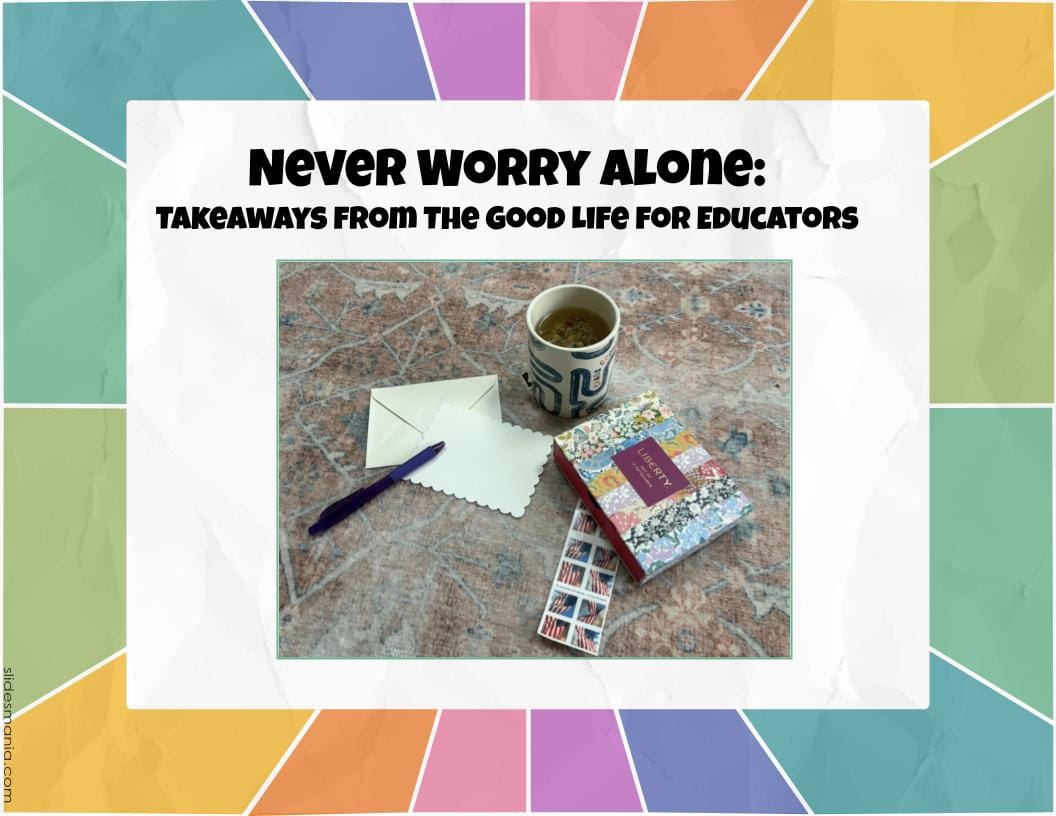
Every time I teach the Good Life for Educators course, I think I have a sense of where the discussion, growth, and learning might go, and every time, I'm off. It unfolds into an utterly different experience with each cohort. The readings, videos, podcasts, and research remain essentially the same, yet each group's stories, questions, joys, and challenges bring new perspectives that reveal the lovely, the hard, and our remarkable capacity to heal and grow in education and life.
As I closed the session, I found myself reflecting on a few lessons I am carrying with me. I thought I'd share them here, and perhaps leave you with a few ideas to ponder in case you ever decide to explore Good Life for Educators: The science of joy and sustainability yourself.
One of my favorite parts of facilitating this and other graduate courses is the incredible range of educators who join. As a language educator, and someone whose career began in social work, I find it brilliant that our conversations include everyone from nurses, special education, psychologists, vice principals, department heads, robotics teachers, social studies, math, English, physics, cinema and literature, theater, chorus, ukulele, art, multilingual, and preschool educators. Although professional development has always encouraged co-curricular work, this course gave us allotted time at our own pace to dive in. Despite how our disciplines differ, the heart of our work is remarkably similar. What resonated most often had less to do with the subject we teach and more to do with the season of life we're in.
Serendipitously, during the final week of the course, an episode of Dr. Vivek Murthy's podcast came out interviewing Dr. Robert Waldinger: The Architecture of a Good Life. In the conversation, Waldinger reflected on the Harvard Study of Adult Development, an 85+ year longitudinal study that has followed the same families across generations, collecting everything from interviews and surveys to brain scans and blood work to better understand what helps people stay healthy, connected, and flourish over the course of their lives. While the episode didn't delve into all of the science and research we explored in our educational context, I was fascinated by Waldinger's description of the "happiest" man in the study.
He explained that after serving in World War II, the man had dreamed of becoming a journalist until his mother became sick, and he returned home to care for her. He ended up accepting a job teaching high school history and became a father of three. He never returned to journalism or made much money, and some people felt he never lived up to his full potential. Instead, he found his joy mentoring students, raising his children, building a sailboat with his grandchildren, and eventually sailing it together. When the Harvard researchers interviewed him again decades later, he was described as one of the most mature and grounded participants in the entire study.
Success isn't always upward movement; sometimes it's deeper roots.
My favorite part of this story was that he was an EDUCATOR. The happiest man in the study wasn't the one with the most impressive résumé, but the one who found meaning in mentoring, teaching, family, and community.
Never Worry Alone
The part of Waldinger's message that stayed with me most wasn't actually about careers though, it was his simple reminder: "Never worry alone."
Throughout The Good Life for Educators, whether we were talking about lessons, learning, or living, relationships matter. Waldinger shared one question researchers returned to throughout the study: "Who could you call in the middle of the night?"
It was fascinating how he explained that even some people who said they were married expressed that they did not have anyone they would call in an emergency. We often convince ourselves that needing help means we don't know enough or aren't strong enough. (And as I write this, I know this is something I am working on. Asking for help does not come naturally or comfortably to me, even when I know I need it). Yet collaboration is not a weakness, it is how humans have always learned. We make sense of the world through conversation, reflection, and shared experiences. Knowing every answer was never meant to be the goal.
Life had already tested that lesson.
The week before school ended, my mom fell. She is living with dementia, and my dad suddenly needed help. If you're an educator, you know how difficult it can feel to step away during the last week of school. Some schools still carry an unspoken stigma about taking time off right before a break, as if we should push through just a little longer.
Instead of worrying alone, I told my colleagues what was happening.
When the final bell rang, my colleagues stayed. They listened and sat with me through a few tears. They didn't rush me or try to fix anything. They simply gave me their attention.
Goodness, did it show me attention is one of the greatest forms of love.
Then I was met with "GO!" No guilt, just support.
So I left to be there for someone else and experienced something we had been discussing throughout The Good Life for Educators course: relationships are not an extra part of a meaningful life. They are the foundation and goodness am I grateful I listened.
This idea kept following me. If attention is one of the greatest forms of love, then gratitude; really, intentionally noticing the people who sustain us, is how we practice it.
Gratitude felt vs. Gratitude expressed
One of the optional assignments in the course came from Dr. Laurie Santos, the Yale psychologist behind the popular course The Science of Well-Being. Her challenge was to write a gratitude letter to someone who has made a meaningful difference in your life and share it with them.
In contrast to previous courses, more participants chose this assignment, and I found myself wondering why. One of the ideas Dr. Santos shares is that we often feel gratitude but rarely express it. We underestimate how meaningful it is for someone to hear the impact they have had on our lives, and we overestimate how awkward those conversations will be. Yet research suggests the opposite: expressing gratitude strengthens relationships, increases well-being for both the giver and the receiver, and helps counter our tendency toward hedonic adaptation, or the human habit of quickly becoming accustomed to the good things in our lives.
Gratitude shifts our attention from what is missing to what is present. It also encourages prosocial behavior. In other words, when we recognize the kindness we've received, we're more likely to extend kindness to others. Gratitude isn't simply a feeling, it's a practice that helps us invest in our future selves, increases our well-being, and in the relationships that sustain us. Research on gratitude letters delivered in person has found that the positive effects can last long after the letter is delivered.
One participant, Mark, reflected on writing a letter to a former mentor named Leo, who taught him that Fridays deserve a Hawaiian shirt, a tradition Mark keeps to this day.
Writing this letter was quite therapeutic. At the time, I’m sure I thanked Leo for his support; however writing this letter helped me truly verbalize the impact he had on me. It has been many years since I have communicated with Leo. I hope to track him down and send him this letter...
His reflection demonstrated how often we may assume people know the difference they have made in our lives. How often do we feel gratitude but never take the time to put it into words?
Mark also shared a tradition from his school: before Thanksgiving break, a colleague hands every student colorful stationery and asks them to write a thank-you to any staff member — teachers, café staff, secretaries. Mark told us about opening his mailbox to find a letter from a student he barely knew:
Thank you for always saying hi to me in the hallway. It always makes me smile.
He never would have guessed he'd made an impact on that student at all.
We rarely know the full impact of our actions. A small moment of attention can become one of the most meaningful moments in another person's life.
Later in the summer, my cousin handed me the book, 365 Thank Yous: The Year a Simple Act of Daily Gratitude Changed My Life, and everything from the course became a real-life example of the Baader–Meinhof phenomenon: an idea enters your awareness, you start seeing it woven into the world around you. Concepts from the course began showing up in unexpected places, connecting in ways I never would have noticed before.
The Good Life
The Good Life is not about having every answer. Many of us in the course discovered that releasing the to-do list was one of our hardest assignments. Oh, how I love a good to-do list. Instead, a good life is built through a web of relationships, each offering something different.
As I think about carrying the lessons from The Good Life for Educators into another school year, it is important to return to the power of small, intentional practices.
We spend so much time helping students build habits that support learning, yet we rarely give ourselves the same opportunity. Flourishing isn't something we achieve at the end of the year; it's something we build one small habit at a time.
Here are three small practices I hope to carry into this school year:
Gratitude.
What I'm trying: A gratitude note or letter a week, even if they're just a Post-it note to a colleague, friend, or a student.
Why it matters: We never really know the impact our words have until we take the time to say, or write, them. Relationships don't grow because we appreciate people; they grow because we tell them we do.
Move.
What I'm trying: An intentional movement throughout my day, not as another item on my to-do list, but as a way to reset.
Why it matters: We know movement supports mood, cognition, and learning. It doesn't have to be about exercise, although that helps too. Sometimes it's simply creating enough space to process, reflect, recharge, or simply a change of scenery for a fresh perspective so we can be present for others.
Brain dump transitions.
What I'm trying: I often struggle with transitions. The transition home after a day of teaching or parenting can be difficult because my mind is still carrying everything from the day and I mindlessly scroll, eat, or saying "mmhmm" to my children without a solid listen. So I'm planning to end each day with a three-minute brain dump to give my brain permission to release what it is carrying and put it down. I'll write down unfinished tasks, ideas, and worries. For now I've been doing it at the end of the day, but I will start doing it before I leave school. I retrieve what I want to remember from the day and leave the rest in the notebook.
Why it matters: As someone who spends a lot of time thinking about the science of learning, this simple practice connects to cognitive load and retrieval. Writing things down helps our brains organize information instead of trying to carry everything at once in our working memory. One participant in our course inspired me with a similar practice. Before she teaches each morning, she writes herself an affirmation in her notebook. This simple ritual helps her begin the day with self-compassion and intention to accept herself and her students as they are, to extend the same grace to herself that she offers her learners, and to remember that every day is a fresh opportunity to learn, grow, and begin again.
So before the school year begins, I'll leave you with the question the Harvard researchers kept returning to: Who could you call in the middle of the night?
Find them. Thank them. And make sure they know it goes both ways. Because relationships don't just make us happier; they make us better educators.
A special thank you to all of you for reading this and for reminding me that we are never meant to do this work alone.