Rethinking Grading Through the Science of Learning
“You all have A's. Now let's get on with learning.” A scene from the film Radical, the research on grades and comments, and what happens when students' attention shifts from the learning to the points.
You all have A's. Now let's get on with learning.
This was the takeaway from a scene in the film Radical (2023) that I have replayed in my head.
The film is based on the true story of Sergio Juárez Correa, an unconventional sixth-grade teacher in Matamoros, Mexico. Sergio arrives at a school where students are growing up amid poverty, violence, and limited educational resources. The school has unreliable electricity, limited internet access, and few functioning computers. His students carry circumstances into the classroom that have little to do with school but inevitably shape what happens there.
In the film’s portrayal of Sergio’s first day, he begins by asking his students to think: "Why do things float?"
No one answers.
“Just take a guess. It doesn’t matter if you’re wrong. What matters is that you try.”
He tells them he actually prefers when they get something wrong because mistakes can help them figure out what is right.
Then a student interrupts.
“But how will we get good grades?”
Sergio asks why the grades matter. The students explain that they need good grades to graduate and so their parents will not be angry.
So he gives them all a 10. Now, he tells them, they can get back to the important stuff.
“So, who wants to be wrong first?”
Sergio’s approach invites us to reconsider what grades, feedback, and our assumptions about learning can reveal about the possibilities students hold. He sees curiosity, questions, and students who are capable of more than a test score or a difficult circumstance.
This scene stayed with me long after the credits because it gets at a question I have been grappling with for years: What happens when attention to the grade begins to compete with attention to the learning?
When the Grade Becomes the Task
Students have legitimate reasons to care about grades.
Grades affect eligibility, athletic participation, college applications, family expectations, and a student’s own sense of how they are doing. Asking about a grade is not a problem in itself.
But I notice something different when the conversation shifts from:
What am I learning?
to:
What do I need to do to get the points?
How many points is this worth?
Is this graded?
What do I need to do to get an A?
A student decides how much effort to put into an assignment based on how much it counts. Another wants to know the exact formula for earning the grade they want.
And suddenly, I am no longer just teaching Spanish…I am negotiating with a number.
Grade-Focused Behavior
There is actually a continuum for grade-focused behavior.
Horne and colleagues (2022) studied what they call the Grade Enquiry Continuum, a framework originally introduced by researcher, Stephanie Frances Allen in 2017. The continuum describes four types of student behavior: grade neutral, grade enquiry, grade challenge, and grade grubbing. Grade enquiry involves trying to understand how one's work relates to a grade. Grade challenge involves questioning a grade with the possibility of recovering points. Grade grubbing is more specifically focused on obtaining a higher grade, with or without justification.
Most of that research comes from higher education, so I am careful about applying it directly to my own students. Still, the larger question matters to me:
What am I teaching students to pay attention to the grade, or the feedback?
Feedback Is Not the Same as a Grade
The more I learn about memory, attention, retrieval, and metacognition, the more I find myself questioning practices that once felt completely normal.
Grading is one of them.
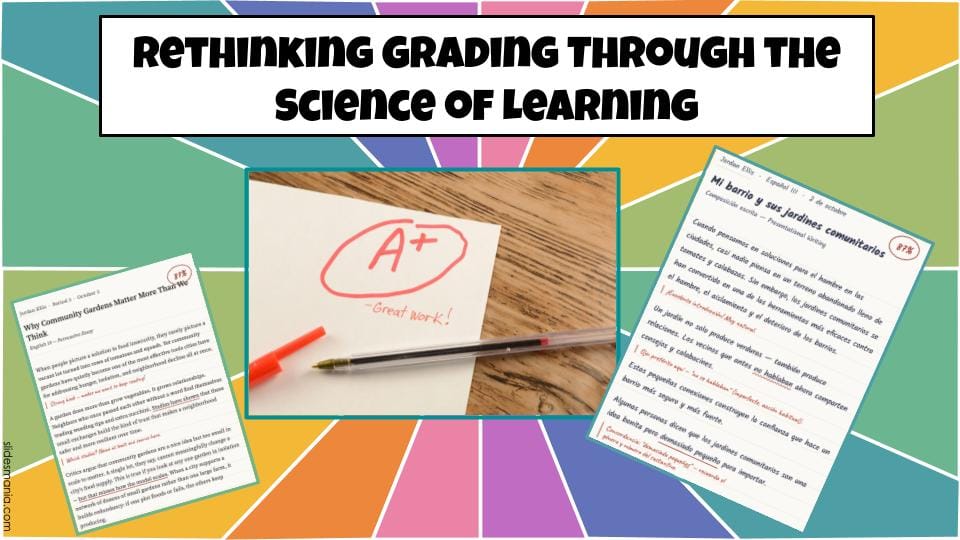
A grade and feedback might appear on the same assignment, but they are doing different jobs. A grade evaluates a performance. Feedback tells a student something about the work: Here is where you are. Here is what is working. Here is what needs attention. Here is what you can try next.
Feedback and grades can coexist, but they are not the same thing. But when we give students both at the same time, which one gets their attention?
I can spend an hour writing thoughtful comments about what a student did well, what they misunderstood, and what they should try next.
And then I put an 87 at the top.
What does the student look at first?
The comments?
Or the 87?

Are We Measuring Learning or Promoting It?
One example that has stuck with me comes from Dylan Wiliam (2018), whose research and writing on formative assessment have helped me rethink grades and feedback.
He describes Joe Rubin, a science teacher in San Francisco, who gives students one grade: an A. Work that meets the standard receives an A. Work that does not is returned with a note explaining that it is not yet ready to be graded, along with suggestions for improvement. He sends the message that everyone can work toward high-quality work, even if some need more time, support, or attempts to get there.
If we are willing to shift our assumptions when better evidence from areas such as cognitive science and educational psychology comes along, that includes asking uncomfortable questions about practices that feel completely normal because we have inherited them.
- What does a grade actually tell a student?
- When does feedback support learning, and when does it simply communicate correctness?
- How do retrieval and memory interact with assessment?
- How do students develop the ability to judge their own learning accurately?
And perhaps most importantly:
Are we using assessment primarily to measure learning, or can we design it to support learning, too?
Although Radical and a couple of research studies will not give us a simple answer, if we tell students that the grade is the destination, we should not be surprised when they start paying close attention to the map instead of the landscape.
When Grades Get in the Way of Feedback
Why might that be?
Butler distinguished between task-involving and ego-involving evaluation. Task-involving feedback keeps attention on the work: what a student understands, what they did, and what they might do next. Ego-involving evaluation makes the student’s performance or ability more salient.
Wiliam (2018) offers one possible explanation: students who received high grades had little reason to engage with the comments, while students who received lower grades were less inclined to do so.
In other words, the grade may pull attention away from the very information students could use to improve.
That does not mean grades are inherently harmful. One study cannot tell us what will happen in every classroom, with every student, on every assessment. But Butler’s findings are not alone.
In a different study, Elawar and Corno (1985) examined constructive written feedback on sixth-grade students' mathematics homework. Teachers in the experimental condition were trained to provide specific feedback about errors, strategies, and ways to improve, and they gave that feedback three times a week for ten weeks. Students whose teachers received this training showed significant gains in mathematics achievement and more positive attitudes toward mathematics than students in the comparison conditions.
Wiliam (2018) summarizes the results in an especially striking way: the students receiving constructive feedback learned in about one week what students in the comparison group took two weeks to learn.
But what happens when we zoom out?
A 2021 meta-analysis by Koenka and colleagues gives this question a broader evidence base. Their synthesis examined research from elementary and secondary education and found that, compared with comments, grades were associated with poorer achievement and less optimal motivation. The effects varied depending on the type of motivation, subject, student characteristics, and research design, so the findings do not mean that grades are universally harmful.
But they do reinforce the question Butler’s study raises:
What happens when the evaluative number grade becomes more salient than the information students could use to improve?
Wiliam (2018) has described the implication even more bluntly: adding marks to comments can wash out the beneficial effects of the comments. That is a particularly uncomfortable thought for those of us who have spent hours writing them.
So Were All Those Comments a Waste of Time?
I have spent A LOT of time writing feedback. And I used to assume that because I wrote thoughtful feedback, students were benefiting from it. Feedback, however, does not produce learning simply because I give it. Students have to notice it, think about it, connect it to what they already know, and, ideally, they need an opportunity and time to use it in class.
If a student reads my comments and then puts the assignment into a binder, backpack, or recycling bin, the feedback is finished. And if the grade draws students' attention away from that feedback, I may unintentionally be undermining my own instructional goals.
But if I can provide an opportunity for student to retrieve something, revise, explain, or try again? That way the assignment or assessment is creating another learning opportunity, and that is where feedback starts to connect more clearly to the Science of Learning.
What I Am Rethinking
I am not getting rid of grades. I teach in a system that uses them, and students have real reasons to care about them.
But I am becoming much more intentional about when the grade appears and what I ask students to do with feedback before the evaluation feels finished.
Before I put a number on an assignment, I try to ask myself:
What do I want my students paying attention to right now?
The score? Or their ideas, word choice, transition words, or what they are doing well, and what could they try differently next time?
Sergio in Radical did not eliminate the idea of success. He moved the grade out of the way long enough for his students to take risks, make mistakes, and think. When done thoughtfully, assessment can become part of the learning itself.
And feedback has to give learners something worth thinking about—and a reason to think about it again. This is where Feedback That Fuels Learning picks up in my next post.
FAQ
Should teachers stop grading altogether?
Grades serve real purposes, and most of us work in systems that require them. The research points to something narrower: when a grade and comments arrive together, students tend to focus on the grade. Separating the two, or holding the grade until students have used the feedback, keeps their attention on the learning.
Research suggests that the presence of a grade can reduce some of the benefits of comments and shift students’ attention toward evaluation.
A 2025 longitudinal study adds some useful nuance. Researchers examined what happened when grades were displayed or hidden while feedback comments remained the same. Grade display was initially associated with lower performance and more negative emotional responses, but those effects diminished over time.
For me, the practical question is not, “Should I grade?”
It is:
What do I want students to notice, and what do I want them to do next?
What did Ruth Butler’s 1988 study find?
Butler studied fifth- and sixth-grade students who received grades, comments, or both. Students who received comments alone showed greater interest and stronger performance than students who received grades, either alone or alongside comments. Adding a grade did not make the comments more effective.
So the question is no longer simply whether grades are “good” or “bad.” It is what students do with the information we give them, and what they pay attention to first.
Is asking about grades the same as grade grubbing?
No. Students care about grades for legitimate reasons, from eligibility and college applications to family expectations.
The Grade Enquiry Continuum, developed by Stephanie Allen and later studied by Horne and colleagues, distinguishes among different forms of grade-focused behavior, including trying to understand a grade, challenging a grade, and seeking points primarily to increase the grade.
That distinction matters. “How did I get this grade?” is not necessarily the same question as “How can I get more points?”
Does this research apply to K–12 language classrooms?
Partly. Butler studied elementary students, while much of the research on grade-focused behavior comes from higher education. I treat them as reasons to ask better questions about my own practice.
References
Allen, S. F. (2017). Questioning the grade: Understanding the complexity of student grade enquiries in higher education [Doctoral dissertation, University of Southampton]. University of Southampton ePrints. https://eprints.soton.ac.uk/
Butler, R. (1988). Enhancing and undermining intrinsic motivation: The effects of task-involving and ego-involving evaluation on interest and performance. British Journal of Educational Psychology, 58(1), 1–14. https://doi.org/10.1111/j.2044-8279.1988.tb00874.x
Davis, J. (2013, October 15). A radical way of unleashing a generation of geniuses. Wired. https://www.wired.com/2013/10/free-thinkers/
Elawar, M. C., & Corno, L. (1985). A factorial experiment in teachers' written feedback on student homework: Changing teacher behavior a little rather than a lot. Journal of Educational Psychology, 77(2), 162–173.
Horne, A., Yuen, J., Beveridge, T., & McLean, S. (2022). Grade-focused interactions in higher education: Has the pursuit for good grades replaced learning? Advances in Physiology Education, 46(4), 752–762.
Koenka, A. C., Linnenbrink-Garcia, L., Moshontz, H., Atkinson, K. M., Sanchez, C. E., & Cooper, H. (2021). A meta-analysis on the impact of grades and comments on academic motivation and achievement: A case for written feedback. Educational Psychology, 41(7), 922–947.
Lipnevich, A. A., Murano, D., Krannich, M., & Goetz, T. (2021). Should I grade or should I comment: Links among feedback, emotions, and performance. Learning and Individual Differences, 89, Article 102020. https://doi.org/10.1016/j.lindif.2021.102020
Panadero, E., & Sánchez-Iglesias, I. (2025). Impact of displaying grades vs. not displaying grades on academic performance and emotional outcomes while delivering feedback comments: A longitudinal study. Educational Assessment, 30(1), 21–40. https://doi.org/10.1080/10627197.2025.2455128
Wiliam, D. (2018). Embedded formative assessment (2nd ed.). Solution Tree.
Zalla, C. (Director). (2023). Radical [Film]. 3Pas Studios; Pantelion Films.