How the First Day of School Became a Metacognitive Practice
Students don't just need to show what they know — they need to notice how they learn. A co-created first-week routine that replaced the syllabus.
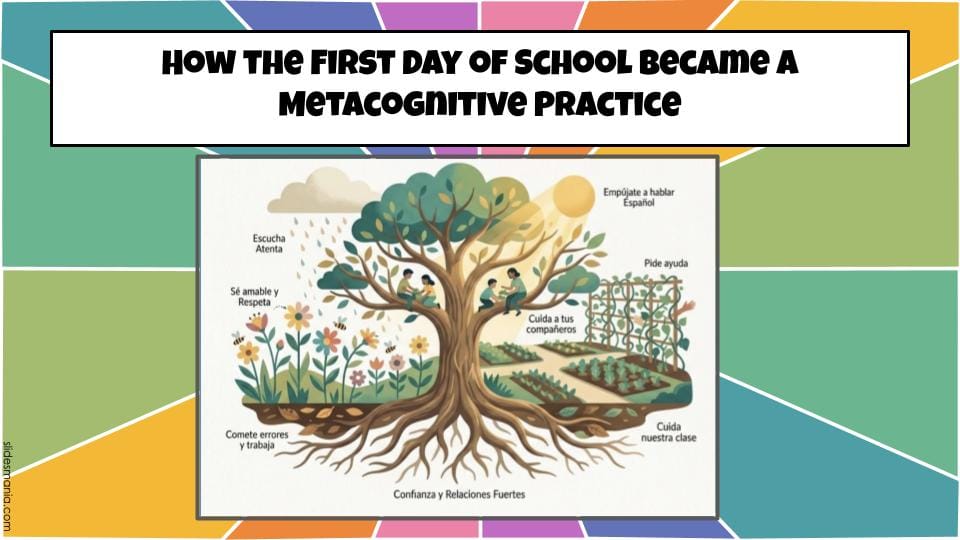
There is something about that first walk through the school after summer. It is a funny feeling of “Oh my gosh, where did summer go?” The floors are freshly waxed, the hallways filled with familiar faces, quick hellos, and conversations that pick up where they left off. You hear the nervous excitement in the students’ voices, see teachers stopping to greet one another, and suddenly, the building is alive again.
I’ve been a “new educator” at a public school six times now, in elementary, middle, and high school. You’d think by now I’d have the first day figured out. But every year, that first day brings its own kind of energy, and I still find myself wondering how to begin.
Even when I’m teaching the same course I taught the year before, I sit down to plan the First Day and somehow convince myself I need to create something completely new. But before I actually get to work, I find plenty of ways to distract myself: fun-colored pens, or the planner I brought home from Spain, anything to avoid deciding what those first few minutes should look like.
Then I ponder whether to start with an intro of myself, name game, find someone who, one word image, music, movement, community-building activities, icebreaker, baseline assessments, circle games, class expectations, surveys...you name it, I've tried it. Some work, some skim the surface, and others flop.
This year, I was inspired by educator Jennifer Haber's The Real Classroom article. What I appreciate about Jennifer's work is that she doesn't write about the theory of what should work, but rather what she sees work in her own classroom. As I read her article and explored her Take Care of Me list, I felt an unexpected sense of recognition. I’ve done the class norm list, the co-created class contract, and watched them work for a while, and I’ve also watched them slowly float away as the year gets busy, often my own doing.
So this year, I tried something different. I split it into three questions: How do we take care of me? How do we take care of you? How do we take care of us? After all my years of teaching K–12, I realized this is not a lesson I need to create for them but rather something we create together.
I put together an entirely different First Day plan, skipped the syllabus entirely and replaced it with a co-created class care story. We built the take care story together in the students' words and I had something I could bring back to their grown-ups at Open House.
It wasn’t until the lessons were over that I realized I had been asking students to look in the mirror as learners: What helps me learn? What gets in my way? What do I need from the people around me? And what might I need from my teacher and from myself?
Here’s how I put it to work in my classroom.
First: Check-In – But really Check-In
What I did: I checked in with everyone using Abelardo Almazán-Vázquez's strategy of first asking students how they are: have they had water, have they slept, are they mentally present? (Note: I did all of this in comprehensible Spanish, but this can be adapted in ANY ways to different languages and subjects).
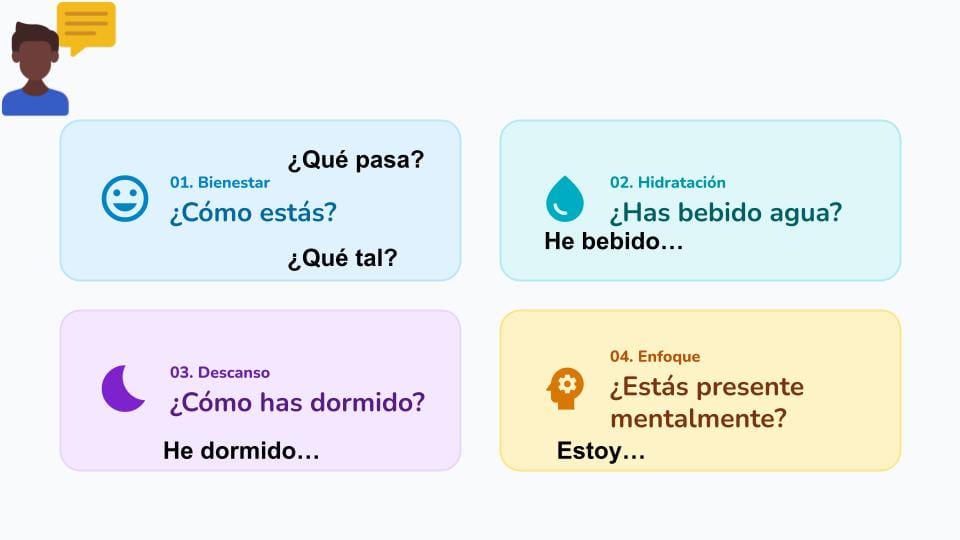
Being in Abelardo's NECTFL session last February as a student reminded me why it matters to communicate: you are a whole person before you are a student in my classroom.
From there, I introduced the three-part framework we would explore and discover together: how to take care of me, how to take care of you, how to take care of us.
How to Take Care of Me (Cómo Cuidarme)
Haber's The Real Classroom explains how to truly think through your 5-10 Take Care items and make them meaningful to your classroom, below are mine. I started by sharing what I needed from students for our classroom community to work.
I explained:
To build a strong community, we need strong relationships based on consideration, respect, and trust. We are all going to make mistakes, ask questions, and take risks.
1. Take Care of Our Class and Classroom
Cuida nuestro salón y clase.
Mantén el salón limpio y trata los materiales con respeto.
When one person speaks, we listen. We listen with our:👂 ears 👀 eyes ❤️ hearts (Cécile Lainé does something wonderfully similar). Everyone deserves to be heard.
2. Make Mistakes. Ask for Help.
Comete errores y pide ayuda.
Mistakes are part of learning Spanish. We need the right amount of challenge, enough to make us think, retrieve, struggle a little (what researchers call desirable difficulty), and try again. You don't have to wait until you're “good enough” to participate. The struggle is part of the learning and your job is to let me know when you don't understand.
3. Take Responsibility for Your Learning.
Sé responsable de tu aprendizaje.
Check Google Classroom. Ask questions. Communicate with me.
I gave students a simple script they could use if they were absent and needed help getting back on track:
Querida profe:
Falté a clase y quiero ponerme al día. ¿Me puedes ayudar con lo que necesito hacer?
Un saludo 👋,
Tu nombre
When students advocate for themselves, they take an active role in their learning. Sometimes students just need the language and the confidence to ask, What do I need to do, and how can I get back on track?
4. Enjoy the Class and Find Joy.
Disfruta de la clase y del proceso de aprender.
5. Trust the Process.
Confía en el proceso.
Sometimes I'm going to ask you to do something that stretches you, work with someone new, or push yourself in another language. Learning a language takes time and there will be words you may not understand, and moments when you make mistakes. It is part of the learning process to take risks together, support one another, and grow. And by the end of the year, I hope we feel a bit like a family.
One of the things I wanted students to know was that they wouldn't have to guess what each day would look like. Having taught in lots of schedule conglomerations in the past, I am currently teaching 80-minute classes on an A/B format, meaning I see students every other day. I've found ways to still hit the mini-quizzes, Write and Discuss, and Friday Feedback routine by sticking to the activators on my Retrieval Para Empezar sheet and this year I am trying out a theme day, which came about based on student interests.
- 📅 Monday: 💬 Storytelling Chat
- 🎭 Tuesday: 🏃 TPR + Retrieval
- 🎵 Wednesday: 🎶 Música, 🎙️ podcast, or real-world connection
- 🔙 Thursday: Throwback Thursday + 🧠 recordamos información
- 📚 Friday: Lectura voluntaria 📖 + reflexión / Friday Feedback
Routines create predictability, which frees up students' cognitive energy for learning. Ones you can actually stick to and stay consistent with are the ones that matter.
After we went through my list, I pulled the main vocabulary from my Cómo Cuidarme (How to Take Care of Me) list and had students brain dump what they remembered so far. We then compiled the list as a class. I wanted to see what students could retrieve before asking them to create their own. We reinforced the vocabulary with a Quizlet Live game, and then students used sentence starters to begin thinking about what they need to take care of themselves and thrive as learners.
Storytime: Take Care in Context
Then came storytime. I start school earlier than my three kids do each year, which means it is a childcare mishmash until they get back to school too. I told this story in Spanish, using the vocabulary from my Cómo Cuidarme lesson. My six-year-old wanted to look his best for first grade, and he took a risk. We had just bought him a pouch full of school supplies. He was playing independently, found his new scissors, and took a risk in cutting his hair.
By the time I got home, he knew he had made a mistake, and we knew that we had made a mistake in not being better about watching him and his access to his new school supplies.
I thought about what I was teaching in class. How do I want to handle mistakes?
And suddenly, my six-year-old’s haircut had become a language lesson.
I want my students to take risks, make mistakes, ask for help, and trust the process. Our mistakes don’t always turn out well. Sometimes they leave us with a very questionable haircut. But that’s how we grow and learn (I learned that the barber isn’t open on Mondays). And sometimes, if we can’t laugh about a mistake in the moment, we can laugh about it later after a little time has passed.
It was my turn to practice what I teach. I knew this couldn't be a story I told on the first day and then left behind. I need to keep sharing the stories of my own blunders and risk-taking, and those of students willing to share theirs.
What Happens When We Make Mistakes?
After the story, I gave students a mini-quiz to check their comprehension. But I also wanted to make a point, so I asked them: Who will remember the answer to this quiz three months from now?
I used an example: One student had me last year and got everything correct on this mini-quiz below. Another student, in my class for the first time, got several questions wrong. When we reviewed the answers, he self-corrected and stopped and thought about what he had misunderstood.
I then asked: If I give this quiz again in three months, which student is more likely to remember?
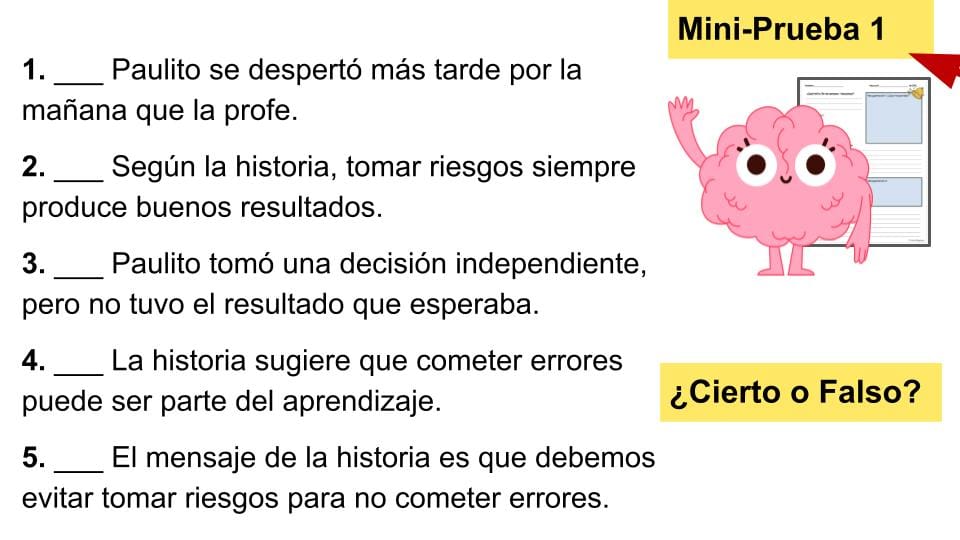
Although I can't give you the answer to the question for another three months, the conversation shifted the focus of the quiz from who got the most right to long-term learning:
- Who pushed through the hard part?
- Who figured out why they were wrong?
- Who learned from the mistake?
- Who retrieved?
Students don't just need opportunities to demonstrate what they know, they need opportunities to notice how they learn and productively struggle. The research on retrieval practice and error correction suggests that there is value in attempting to retrieve information, even when the attempt is unsuccessful. When students make an error and then receive corrective feedback, they have an opportunity to process the correct answer and strengthen what they know.
How to Take Care of You
By this point, students had encountered the Cómo Cuidarme vocabulary in several ways: through the story, their brain dump, Quizlet, and sentence starters. Then I gave them some quiet, independent time to think about five ways I could take care of them and help them thrive as learners.
They wrote their ideas down and shared them with a partner. Then we brought their ideas back to the whole class.
And this is where me became you, and you became us.
Co-Create How to Take Care of Us
After students created their own lists, I gave them a three-question exit ticket:
- What are you most nervous about?
- What are you most excited about?
- What is the most important item on your How to Take Care of Me list?
I collected all of their responses and turned them into a graphic so we could see our collective thinking the following day, and then we talked.
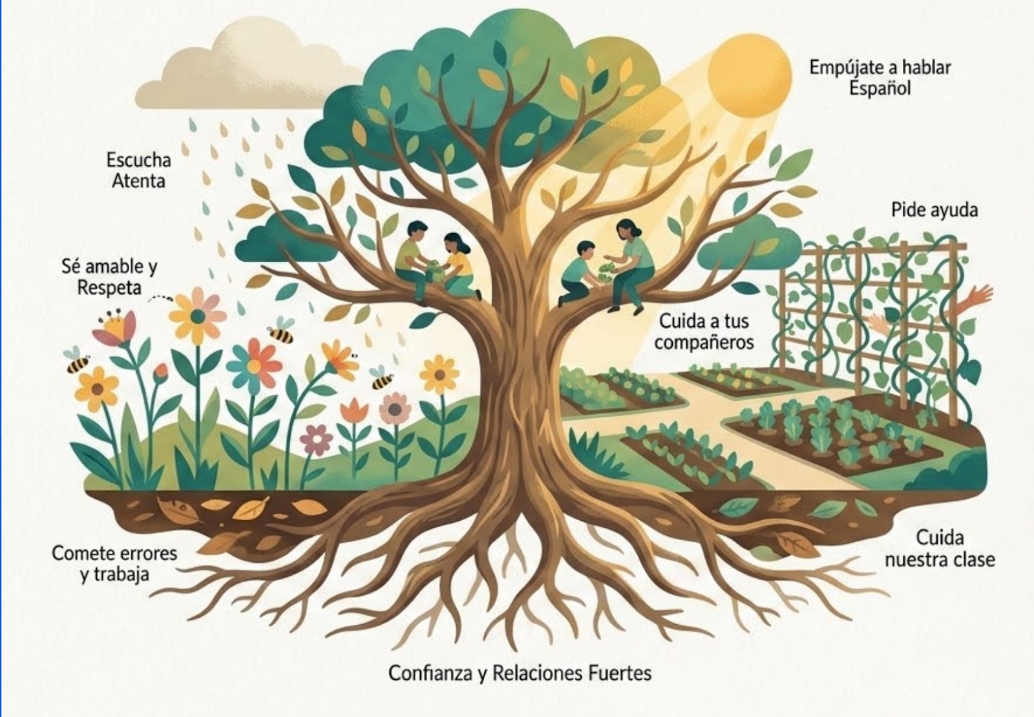
Students first turned to a partner and explained which item mattered most to them. Then they partnered again with the two students behind them. Finally, each group shared out during our Write and Discuss and we co-created the take-aways. Below are examples of the first drafts:
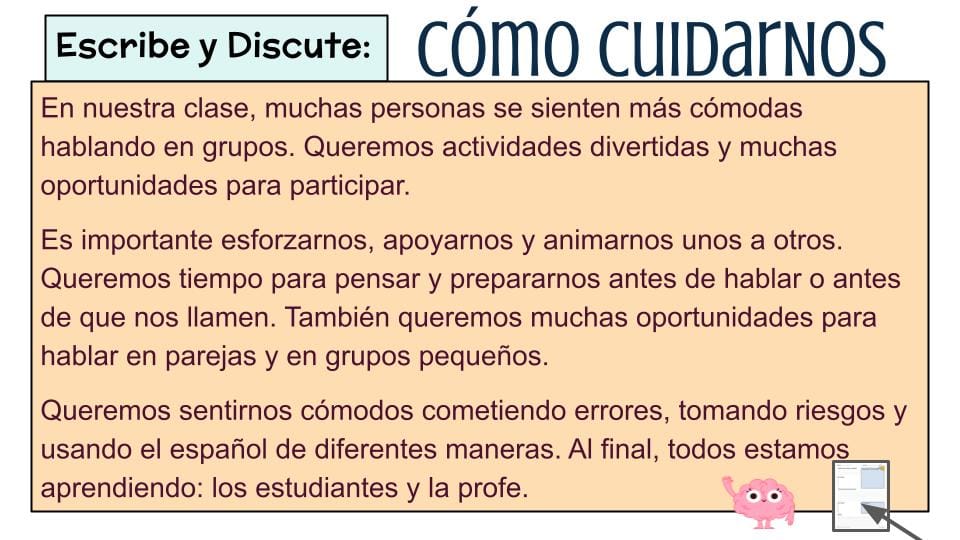
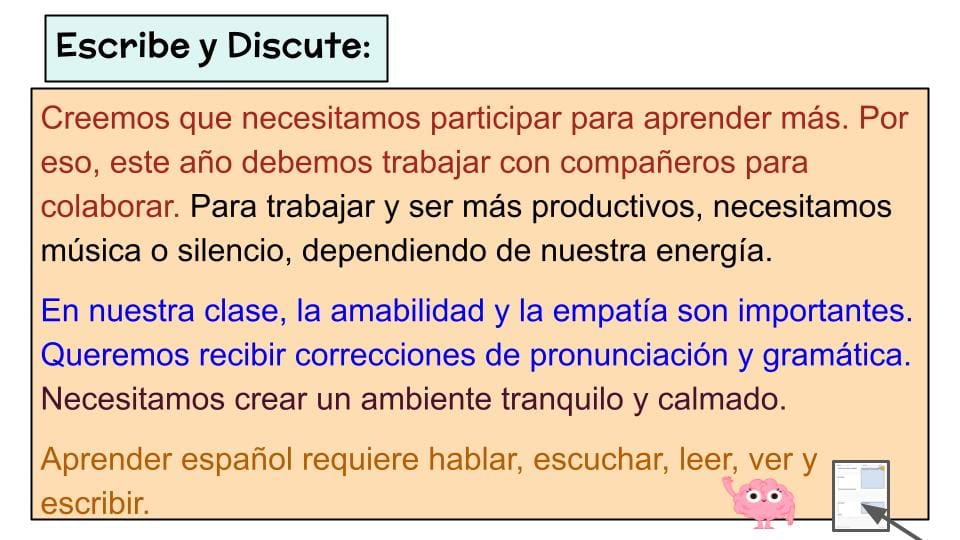
We found the conversation moved from:
“Here is what I need.”
to:
“Here is why I need it.”
And then to:
“What do we need from one another?”
We revisited and read the Write and Discuss passages the following day to see if there was anything we wanted to add or change for each class. This ended up becoming a series of metacognitive opportunities where students were thinking about:
- what helps them feel ready to learn;
- what makes them nervous;
- what motivates them;
- what they need from their teacher;
- what they need from their classmates;
- how they respond to mistakes;
- what it means to take a risk;
- and what kind of learner they want to be.
We ended the week with Friday Feedback, and their responses included reflections about how they could level-up their language skill and what I could do to create the conditions for them to take risks.
Some of the responses included requests for low-pressure opportunities to practice speaking Spanish with a partner, on Speakable, or in a small group before sharing with the whole class. Students asked me not to rely on cold calls, and when I do call on them, to use a predictable order so everyone knows when their turn is coming.
They reminded me that sometimes silence is exactly what they need. Other times, music can shift the energy of the room. More than once, students asked me to answer their questions, clear up their doubts, be patient, explain expectations clearly, and keep checking in with them as the year progresses.
My biggest takeaway from this year’s first week? I don’t think I need to find the perfect first-day activity anymore. Phew!
Maybe the goal isn’t to create the most exciting first day. Maybe it’s to create a first day that gives students, and ourselves, a chance to pause and ask: What do I need to learn well in this class? What do you need to teach well? And what can we do together to take care of us?
This is what metacognition looks like when it lives in a routine instead of a worksheet. Not a reflection prompt at the end of a unit, but a question students answer on day one and keep answering all year.
Where the Idea Went Next
After I shared this framework, my director, Denise, adapted it for her own classes. Here's where she's taking it:
Using student feedback, I created five categories for how I can take care of them. Each category included action steps that students reviewed in the next class.
I put each category and its action steps on a large piece of paper and posted them around the classroom. Students walked around with sticky notes, sharing edits, reactions, questions, and concerns. Many students shared that a particular category mattered to them because it addressed something that caused apprehension or worry.
Whatever they shared, I was able to begin building norms that offered students comfort and security in an environment that welcomed and expected mistakes, while also challenging them to embrace growth through discomfort.
For the first time in my 27-year career, my first-day activity felt purposeful and meaningful for everyone, rather than another list of rules students could tune out.
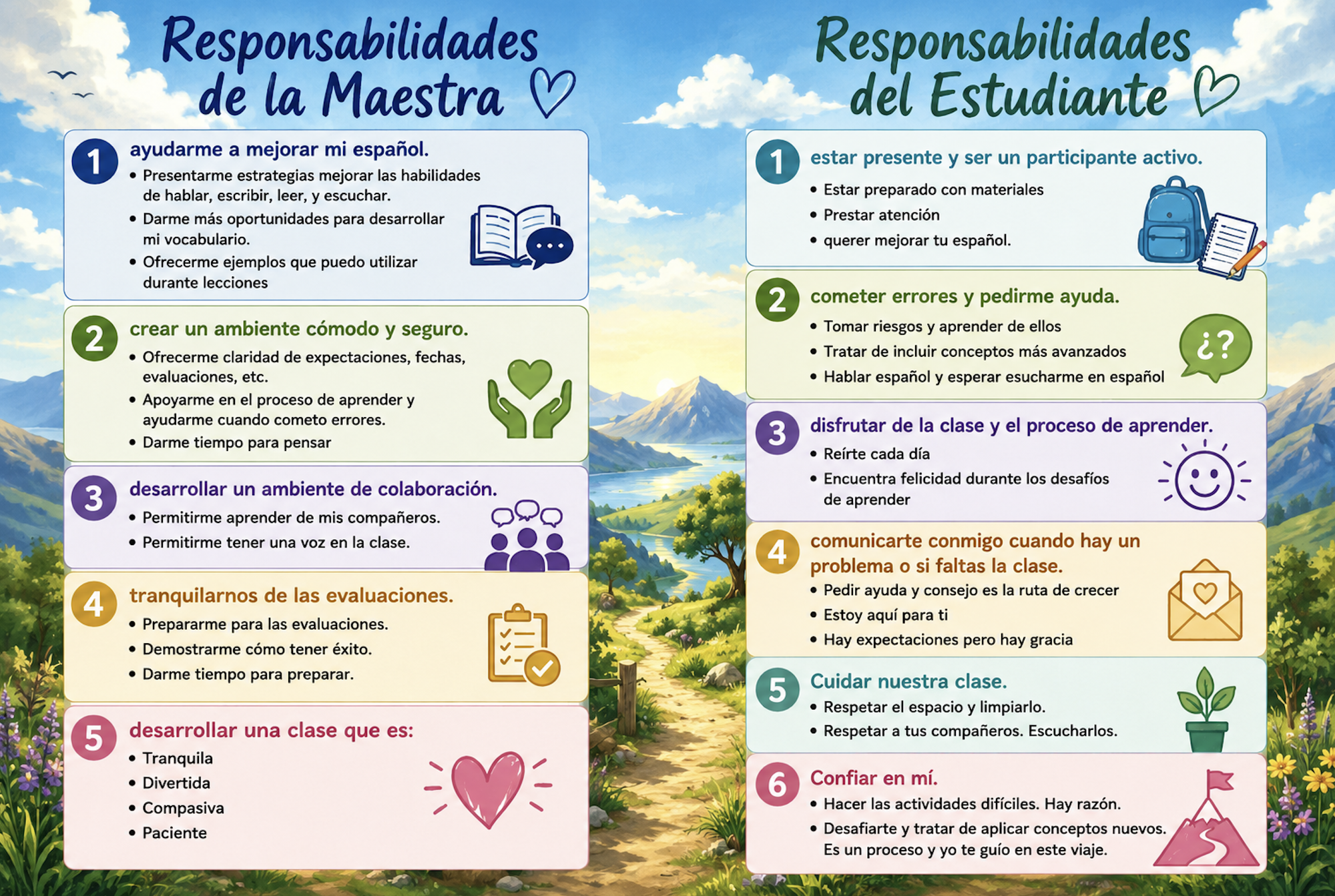
A first-day lesson stays in one classroom. A question students helped write travels.
Here is a template of my lesson if you want to try it.