Wait Time: What My First Grader Taught Me
My first grader caught me giving him the answer. What that moment taught me about wait time, listening to student thinking, and giving the thinking back.
This is the story that inspired my recent Edutopia article.
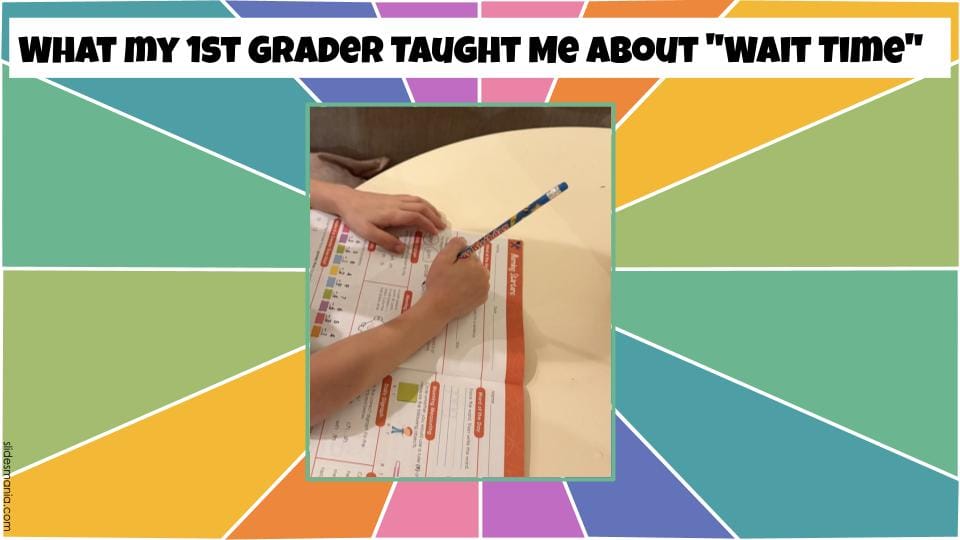
It was the end of the day. I had already played catch and made herculean efforts to get my three children to sit at the table for dinner. I was finally chipping away at the dishes when my youngest son asked if we could work on his first-grade workbook together.
How could I say no? I’ve been trying to get him to read.
He started by tracing a word and adding its ending, but the next activity suddenly jumped to bigger words. His cognitive load went up without the scaffolding he needed, and he wanted my help.
So there I was, sounding out the words for him, when he called me out.
“Mom! You are telling me the answer.”
Yep. I was.
The truth was, I wanted to get the show on the road: pajamas, teeth brushed, bedtime, and maybe a moment to myself. His comment stopped me in my tracks. I hadn’t given him time to think through the words himself.
Scaffolding helps a learner manage a task that currently overwhelms them. That could have meant asking him which sounds he already knew, giving him a cue, or breaking the word into smaller chunks. Instead, I skipped straight to the answer. I didn’t lighten the load. I took the thinking away.
So what did I do then? Well, first, I owned it: “Sorry about that, buddy. Show me what you can do.” Then I took a deep breath, folded my hands in my lap, and waited. When he began to struggle, I kept my mouth shut, gave it another moment, and used my finger to show him where he was as he sounded out the word. Then I stayed present, pushing thoughts of bedtime out of my mind, and sat in the uncomfortable silence while he worked it out.
It took a while, but he got there. And he was proud of himself, because the thinking was his.
The same thing happens in my classroom
I’d love to say this only happens at home after a long day. It doesn’t. The same pull to keep things moving shows up in my classroom, and it costs them the chance to work it out themselves.
Research backs up what my son told me. In Embedded Formative Assessment, Dylan Wiliam (2018) describes research by Ted Wragg and his colleagues, who analyzed 1,000 teacher questions. Only 8 percent required students to analyze, make inferences, or generalize. Wiliam concludes that fewer than 10 percent of the questions actually caused any new learning (p. 90). Ouch.
Some of that comes down to time. When we give students longer wait time, they talk more and give longer, more thoughtful answers (Rowe, 1986; Shiau et al., 2024). And some of it comes down to the question itself. If I’m asking about something I said 20 seconds ago, students are just recognizing it. They aren’t really retrieving anything.
And once students do answer, I have to ask myself:
What will I do with their answer?
Wiliam (2018) describes this as learning to “listen interpretively”: recognizing that students’ responses can inform how we teach and adjust instruction (p. 98). I’m not asking questions to collect correct answers. I’m asking because students’ thinking tells me what to do next.
Students notice the difference. Hodgen and Wiliam (2006) share one student’s description of the change in her teacher:
“When Miss used to ask a question, she used to be interested in the right answer. Now she’s interested in what we think” (p. 16).
Giving the thinking back
My son reminded me of something I already knew but need to hear again: sometimes the most helpful thing I can do is wait and say less. In my latest Edutopia article, I share three practical ways I give students time to do their own thinking.
→ Read the full article on Edutopia: Giving Students Time to Do Their Own Thinking
References
Hodgen, J., & Wiliam, D. (2006). Mathematics inside the black box: Assessment for learning in the mathematics classroom. NFER-Nelson.
Rowe, M. B. (1986). Wait time: Slowing down may be a way of speeding up! Journal of Teacher Education, 37(1), 43–50. https://doi.org/10.1177/002248718603700110
Shiau, A. Y. A., McWilliams, K., & Williams, S. (2024). The role of wait time during the questioning of children: A systematic review. Trauma, Violence, & Abuse, 25(5), 3441–3456. https://doi.org/10.1177/15248380241246793
Wiliam, D. (2018). Embedded formative assessment (2nd ed.). Solution Tree Press.